Biology News Net
RSS 2.0 Feed
Biology


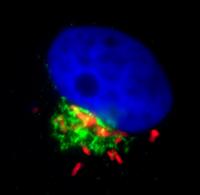
The picture shows a phycobiliphyta cell in fluorescence microscope. The cell nucleus is colored in blue, the cytoplasma in green. The red fluorescence comes from a plastide with phycobiliproteins, pigments that usually occur in red algae, cyanobacteria and cryptophyceae. The cell measures 2x5 µm (1µm = 1/1000 millimeter).

Credit: Fabrice Not/Station Biologique de Roscoff An international group of researchers has succeeded in identifying a previously unknown group of algae. As currently reported in the scientific journal Science, the newly discovered algae are found among the smallest members of photosynthetic plankton - the picoplankton ('Picobiliphytes: A marine picoplanktonic algal group with unknown affinities to other Eukaroytes" Science, Vol. 316'). On account of the minute size of the organisms (no more than a few thousandth of a millimetre) and the appearance of phycobili-proteins, researchers have termed the new group Picobiliphyta.

Biology

An international team of scientists including Université Laval biologist Connie Lovejoy has discovered new life forms in the Arctic Ocean. The team's findings are reported in the January 12 edition of the journal Science.

Health & Medicine

Canadian scientists have found astonishing evidence that the lifelong use of two languages can help delay the onset of dementia symptoms by four years compared to people who are monolingual.

Molecular & Cell Biology


Fluorescent staining shows Campylobacter jejuni (red) inside a cell and microtubules of the cytoskeletal network (green) at 6 hours after infection.
Yale researchers now have some answers about how the bacterium that is the leading cause of food-borne illness in the United States enters cells of the gut and avoids detection and destruction, according to a presentation at the annual meeting of the American Society for Cell Biology in San Diego in December.

Molecular & Cell Biology

Researchers at Rensselaer Polytechnic Institute have found a new pathway by which cells change their adhesive properties. With a $1.4 million grant from the National Institutes of Health, they plan to fill in the details behind how cells decide to stick to a surface, which could lead to a better understanding of the importance of this pathway to the physiology and development of organisms.

AIDS & HIV

While there is no cure for lingering viral infections such as HIV and herpes, a recent study at Princeton University suggests it may be possible to deactivate such viruses indefinitely with the flick of a genetic switch.

Bioinformatics

Researchers have decoded the genetic makeup of the parasite that causes trichomoniasis, one of the most common sexually transmitted infections (STIs), revealing potential clues as to why the parasite has become increasingly drug resistant and suggesting possible pathways for new treatments, diagnostics and a potential vaccine strategy. The genome sequencing project, funded by the National Institute of Allergy and Infectious Diseases (NIAID), part of the National Institutes of Health (NIH), is detailed in the January 12 issue of Science.

Molecular & Cell Biology

Scientists have revealed the intricate structure of cartilage in what they hope will provide clues to how the crippling joint disease osteoarthritis might one day be treated.

Molecular & Cell Biology

New research shows that a recently discovered enzyme that destroys the messenger RNA (mRNA) for some proteins can also help to protect the mRNA during times of stress. The response might help cancer cells survive chemotherapy and radiation therapy.