


The Atlantic Ocean doesn't receive the mother lode of fixed nitrogen, the building block of life, after all. Instead, comparing fathom for fathom, the Pacific and Indian oceans experience twice the amount of nitrogen fixing as the Atlantic, say researchers in the Jan. 11 issue of Nature.

| Stem Cell Research | January 10, 2007 09:20 PM |
Cambridge scientists have discovered the stage at which some of the cells of a fertilised mammalian egg are fated to develop into stem cells and why this occurs. The findings of the study, which overturn the long-held belief that cells are the same until the fourth cleavage (division) of the embryo, are reported in today's edition of Nature.
| Full story | 0 Comments | 6173 views |

| Biology | January 10, 2007 08:20 PM |
In many animals, males advertise to potential mates with showy traits, many of which are linked to testosterone levels. However, a new study suggests that, in fish, choosing a flashier mate may cause future generations to be more susceptible to pathogens.
| Full story | 0 Comments | 6705 views |
| Biology | January 10, 2007 07:20 PM |
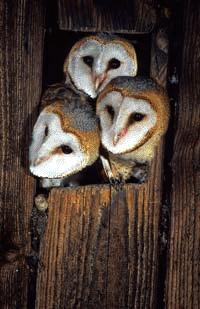
Young barn owls waiting for the return of a parent with prey. Fluctuations in weather and the environment affect survival and reproduction of animals. But are all individuals within a population equally susceptible? Theory on the evolution in age-structured populations suggests not – those life stages that are more important for overall fitness should be less susceptible to environmental variation than other life stages.
| Full story | 1 Comment | 5693 views |
| Biology | January 10, 2007 06:20 PM |

Waterfowl are "careful, sophisticated bargainers," negotiating not only how much effort each puts into communal rearing of ducklings, but also profit-sharing, says a new study from the American Naturalist. Female eider ducks are well known to team up and share the work of rearing ducklings, but it now appears that they also negotiate not only how much effort each puts into the partnership, but also profit-sharing. An international group of scientists used a long-running study of the eider population in a Finnish archipelago to test predictions about how each hen seeks to maximize her benefits from the partnership without making it so unattractive that other hens withdraw their participation.
| Full story | 0 Comments | 5789 views |
| Biology | January 10, 2007 05:20 PM |
A newly identified wheat gene produces proteins that appear to attack the stomach lining of a crop-destroying fly larvae so that the bugs starve to death.
| Full story | 0 Comments | 5808 views |

- In some genetic cases of microcephaly, stem cells fail to launch
- Yale team discovers how Zika virus causes fetal brain damage
- Scientists uncover the way a common cell enzyme alerts the body to invading bacteria
- Arctic gives clues on worst mass extinction of life
- Calcium channel blockers caught in the act at atomic level
Search Bio News Net
Free Biology Newsletter
- Flexibility That A.C.A. Lent to Work Force Is Threatened by...International Herald Tribune
- Bacteria Behind Legionnaires’ Disease Found at New York Police StationInternational Herald Tribune
- Prescription Price Crisis? 28 Million Americans See Spike in Drug...MSNBC.com: Health
- Seizing on Opioid Crisis, a Drug Maker Lobbies Hard for...International Herald Tribune
- Republicans are taking a big political risk on health careAP Health News
- Why We're So Divided Over Saving WolvesNational Geographic News