

The formation of long-term memory in fruit flies can be demonstrated by the influx of calcium into cells called mushroom body neurons that occurs after special training that includes periods of rest, said researchers from Baylor College of Medicine (BCM) in a report that appears in the current issue of the journal Neuron.

| Health & Medicine | December 6, 2006 10:08 PM |
The genetic basis for a rare inherited disorder that causes severe burning pain with no warning has been pinpointed by researchers. They found that paroxysmal extreme pain disorder (PEPD) is caused by specific mutations in porelike sodium channels in peripheral nerve cells—a discovery that they said emphasizes the role of such channel disorders in inflammatory pain. Such findings of abnormal function in disease also provide insights into the normal function of such channels, they said.
| Full story | 0 Comments | 6307 views |

| Microbiology | December 6, 2006 09:08 PM |
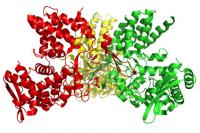
The atomic structure of influenza A virus nucleoprotein. Credit: Jane Tao/Rice University Striking new research from Rice University and the University of Texas at Austin (UT) has revealed a potential new target that drug makers can use to attack several strains of influenza, including those that cause bird flu as well as the common variety that infects millions each flu season.
| Full story | 0 Comments | 6356 views |

| Molecular & Cell Biology | December 6, 2006 08:08 PM |
More than half of the human genome is made up of bits of mobile DNA, which can travel inside the body and insert genes into the chromosomes of target cells. This DNA doctoring not only shapes species over time, it also spreads antibiotic resistance and is used by bacteria that spread Lyme disease and by viruses linked to certain forms of cancer.
| Full story | 0 Comments | 4558 views |
| Health & Medicine | December 6, 2006 07:19 PM |
The early stages of coronary artery disease in young smokers can be reversed quickly if they choose to put out their cigarettes for good, according to a positron emission tomography (PET) imaging study in the December Journal of Nuclear Medicine.
| Full story | 0 Comments | 4770 views |

| Biology | December 6, 2006 06:19 PM |
If I can't remember this morning where I put my car keys last night, it's due to my memory failing me again. Scientists at the Max Planck Institute for Medical Research in Heidelberg have been investigating how memories might be consolidated. Their new study offers the hitherto strongest proof that new information is transferred between the hippocampus, the short term memory area, and the cerebral cortex during sleep. According to their findings and contrary to previous assumptions, the cerebral cortex actively controls this transfer. The researchers developed a new technique for their investigations which promises previously impossible insight into the largely under-researched field of information processing in the brain (Nature Neuroscience, November 2006).
| Full story | 0 Comments | 8132 views |
| Biology | December 6, 2006 02:47 PM |
It is commonly thought that animals can be arranged along a ladder of intelligence—a sort of modern-day Scala Naturae—with humans inevitably at the top, followed by our close relatives, the primates, all the way down to fish and other slimy creatures. Over the past decade, this ladder has been challenged by claims of high intelligence and great social complexity in other animals. For example, spotted hyenas establish hierarchies in which dominant females support the rank contests of their daughters. Bottlenose dolphins form "political" coalitions every bit as complex as those of chimpanzees. Caledonian crows not only use tools in the wild, but also modify tools in the lab, an ability once thought to define humans.
| Full story | 0 Comments | 5083 views |
| Health & Medicine | December 6, 2006 12:47 PM |
Information on the global burden of malaria remains the subject of "best guesses," and as a result resource allocation for malaria control remains "driven by perceptions and politics, rather than an objective assessment of need," say two prominent malaria researchers in PLoS Medicine.
| Full story | 0 Comments | 6189 views |

| Stem Cell Research | December 6, 2006 10:19 AM |
It's not easy to make one plus one equal one. But biological engineer Chang Lu has done just that with a new and cheaper method to electrically fuse cells - a vital technology for studying stem cells, creating clones and finding disease antibodies.
| Full story | 0 Comments | 4330 views |

- In some genetic cases of microcephaly, stem cells fail to launch
- Yale team discovers how Zika virus causes fetal brain damage
- Scientists uncover the way a common cell enzyme alerts the body to invading bacteria
- Arctic gives clues on worst mass extinction of life
- Calcium channel blockers caught in the act at atomic level
Search Bio News Net
Free Biology Newsletter
- Flexibility That A.C.A. Lent to Work Force Is Threatened by...International Herald Tribune
- Bacteria Behind Legionnaires’ Disease Found at New York Police StationInternational Herald Tribune
- Prescription Price Crisis? 28 Million Americans See Spike in Drug...MSNBC.com: Health
- Seizing on Opioid Crisis, a Drug Maker Lobbies Hard for...International Herald Tribune
- Republicans are taking a big political risk on health careAP Health News
- Why We're So Divided Over Saving WolvesNational Geographic News