

People with HIV have been living longer, healthier lives since the development of highly active antiretroviral therapy (or HAART) in 1995. In fact, most patients on the drug regimen do so well that, according to blood tests, their immune cells appear to return to pre-HIV levels. But two new studies from Rockefeller University and the Aaron Diamond AIDS Research Center (ADARC) show that the immune cells in other body tissues may never rebound, suggesting the need for additional ways to monitor immune system health, and the need for hypervigilance as HIV-positive patients live into their forties, fifties, sixties and beyond. The findings are reported in today's issue of PLoS Medicine and online in the Journal of Virology.

| Molecular & Cell Biology | December 5, 2006 10:19 PM |
A new study in the December issue of the journal Cell Metabolism, published by Cell Press, offers insight into the manner in which the mammary glands of mammals meet the incredible metabolic demands of milk production. As the normal pathways of breast development undoubtedly affect breast cancer, the findings may have therapeutic implications, the researchers said.
| Full story | 0 Comments | 4148 views |

| AIDS & HIV | December 5, 2006 09:47 PM |
Most of the body’s memory T cells vanish within weeks after a person is infected with the HIV virus. In a study from the Aaron Diamond AIDS Research Center and the Bernard-Nocht Institute appearing in the international open-access journal PLoS Medicine, researchers report that these memory T cells, mostly found in the digestive tract, tend not to return to normal even after years of treatment for HIV.
| Full story | 0 Comments | 4457 views |
| Molecular & Cell Biology | December 5, 2006 08:19 PM |
New research identifies an important gene that influences several aspects of nicotine-induced behaviors in the brain. The study, funded by National Institutes of Drug Abuse, was presented today at the American College of Neuropsychopharmacology's Annual Meeting.
| Full story | 0 Comments | 7080 views |

| Health & Medicine | December 5, 2006 07:19 PM |
The popular hair-growth drug finasteride, taken by millions of balding men, artificially lowers the results of the prostate-specific antigen (PSA) test, the standard screening test for prostate cancer, a multicenter study has found.
| Full story | 0 Comments | 4655 views |
| Molecular & Cell Biology | December 5, 2006 06:19 PM |
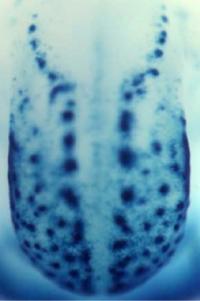
The pattern of active wnt protein (dark blue) follows the development of taste papillae and buds in the tongue of a mouse. Credit: Sarah Millar, University of Pennsylvania School of Medicine; Linda A. Barlow, University of Colorado Health Sciences Center; Nature Genetics Of the five senses, taste is one of the least understood, but now researchers at the University of Pennsylvania School of Medicine have come one step closer to understanding how the sense of taste develops. They have pinpointed a molecular pathway that regulates the development of taste buds. Using genetically engineered mice, they discovered that a signaling pathway activated by small proteins called Wnts is required for initiating taste-bud formation. They have also determined that Wnt proteins are required for hooking up the wiring of taste signals to the brain.
| Full story | 0 Comments | 4894 views |

| Biology | December 5, 2006 05:19 PM |
When a newt loses a limb, the limb regrows. What is more, a newt can also completely repair damage to its heart. Scientists at the Max Planck Institute for Heart and Lung Research in Bad Nauheim have now started to decode the cellular mechanisms in this impressive ability to regenerate and have discovered the remarkable plasticity of newt heart cells. As mammals, and therefore also humans, do not have this ability, the findings could contribute to new cell therapies for patients with damaged organs (Journal of Cell Science, 2006).
| Full story | 0 Comments | 6821 views |
| Molecular & Cell Biology | December 5, 2006 04:40 PM |
Scientists have discovered that mutations in a gene known as SOS1 account for many cases of Noonan syndrome (NS), a common childhood genetic disorder which occurs in one in 1,000-2,500 live births. NS is characterized by short stature, facial abnormalities, and learning disabilities, as well as heart problems and predisposition to leukemia.
| Full story | 0 Comments | 6461 views |
| Health & Medicine | December 5, 2006 02:40 PM |
Transplanted neural stem cells hold promise for reducing the destruction of dopaminergic cells that occurs in Parkinson’s disease and for replacing cells lost to the disease, scientists say.
| Full story | 0 Comments | 5013 views |
| Molecular & Cell Biology | December 5, 2006 12:40 PM |
The popular view is that DNA and genes control everything of importance in biology. The genome rules all of life, it is thought.
| Full story | 0 Comments | 4922 views |
| Biology | December 5, 2006 10:40 AM |
Worker bees, wasps, and ants are often considered neuter. But in many species they are females with ovaries, who although unable to mate, can lay unfertilized eggs which turn into males if reared. For some species, such as bumble bees, this is the source of many of the males in the species. But in others, like the honeybee, workers "police" each other – killing eggs laid by workers or confronting egg-laying workers.
| Full story | 0 Comments | 9173 views |

- In some genetic cases of microcephaly, stem cells fail to launch
- Yale team discovers how Zika virus causes fetal brain damage
- Scientists uncover the way a common cell enzyme alerts the body to invading bacteria
- Arctic gives clues on worst mass extinction of life
- Calcium channel blockers caught in the act at atomic level
Search Bio News Net
Free Biology Newsletter
- Flexibility That A.C.A. Lent to Work Force Is Threatened by...International Herald Tribune
- Bacteria Behind Legionnaires’ Disease Found at New York Police StationInternational Herald Tribune
- Prescription Price Crisis? 28 Million Americans See Spike in Drug...MSNBC.com: Health
- Seizing on Opioid Crisis, a Drug Maker Lobbies Hard for...International Herald Tribune
- Republicans are taking a big political risk on health careAP Health News
- Why We're So Divided Over Saving WolvesNational Geographic News