


Microbes may compete with large animal scavengers by producing repugnant chemicals that deter higher species from consuming valuable food resources -- such as decaying meat, seeds and fruit, a new study suggests.

| Health & Medicine | November 1, 2006 10:18 PM |
Scientists at St. Jude Children's Research Hospital have demonstrated in a mouse model a new, locally applied treatment for the eye cancer retinoblastoma that not only greatly reduces the size of the tumor, but does so without causing the side effects common with standard chemotherapy. The treatment also appears to be suitable for certain forms of breast, lung, prostate and colon cancer, and is simple enough for widespread use even in countries with limited resources.
| Full story | 0 Comments | 5309 views |

| Stem Cell Research | November 1, 2006 09:18 PM |
Researchers at the University of Minnesota have, for the first time, coaxed umbilical cord blood stem cells to differentiate into a type of lung cell.
| Full story | 0 Comments | 6277 views |

| Biotechnology | November 1, 2006 08:18 PM |
Mechanical 'artificial hearts' can be used to return severely failing hearts to their normal function, potentially removing the need for heart transplantation, according to new research.
| Full story | 0 Comments | 5703 views |

| Biology | November 1, 2006 07:18 PM |
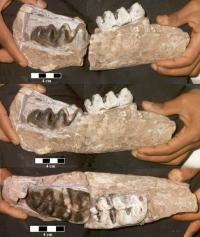
The teeth of the newly described Eritreum melakeghebrekristosi are a tip-off to its position as a missing link in the elephant family tree. Courtesty of U-M News Service A pig-sized, tusked creature that roamed the earth some 27 million years ago represents a missing link between the oldest known relatives of elephants and the more recent group from which modern elephants descended, an international team that includes University of Michigan paleontologist William J. Sanders has found.
| Full story | 0 Comments | 5319 views |
| Health & Medicine | November 1, 2006 06:48 PM |
New research here suggests that hormones produced as during periods of stress may increase the growth rate of a particularly nasty kind of cancer.
| Full story | 0 Comments | 5398 views |
| Biology | November 1, 2006 06:18 PM |

Researchers from Spain looked at population data for the Spanish imperial eagle (Aquila adalberti) over the last century. With less than 150 pairs in the whole Iberian Peninsula, this eagle is one of the most threatened raptors in the world. Courtesy Penteriani et al. In a paper from the November issue of The American Naturalist, Vincenzo Penteriani, Fermín Otalora, and Miguel Ferrer, researchers at the Estación Biológica de Doñana (Consejo Superior de Investigaciones Científicas, Spain), focus on the forgotten and invisible side of animal populations - the floaters. Floaters are dispersed individuals who enter the reproductive population when breeding territory or a potential mate become available.
| Full story | 0 Comments | 4977 views |
| Health & Medicine | November 1, 2006 04:49 PM |
New autopsy data provide the strongest evidence yet that sudden infant death syndrome (SIDS) is not a "mystery" disease but has a concrete biological basis. In the November 1 issue of JAMA, researchers at Children's Hospital Boston document abnormalities in the brainstem – a part of the brain that regulates breathing, blood pressure, body heat, and arousal – in babies who died from SIDS.
| Full story | 0 Comments | 7016 views |
| Health & Medicine | November 1, 2006 02:49 PM |
As if creaking joints and hardening of the arteries weren't bad enough, a research team from the University of Delaware and the Christiana Care Health System in Newark has now confirmed that even our veins stiffen as we age.
| Full story | 0 Comments | 5607 views |

| Molecular & Cell Biology | November 1, 2006 12:49 PM |
The discoverers of the unique mouse line that is resistant to cancer have begun to pin down how the process works and found that white blood cells in these mice overwhelm normal defenses of cancer cells.
| Full story | 0 Comments | 6515 views |
| Health & Medicine | November 1, 2006 10:49 AM |
The next generation of treatments for shock or stroke could be based on a protein that is already in our heads – neuroglobin. In a review article to be published in the November issue of The FASEB Journal, scientists from University of Rome describe this protein, which may be the key to unlocking new therapies to minimize brain damage and improve recoveries for patients.
| Full story | 0 Comments | 5892 views |

- In some genetic cases of microcephaly, stem cells fail to launch
- Yale team discovers how Zika virus causes fetal brain damage
- Scientists uncover the way a common cell enzyme alerts the body to invading bacteria
- Arctic gives clues on worst mass extinction of life
- Calcium channel blockers caught in the act at atomic level
Search Bio News Net
Free Biology Newsletter
- Flexibility That A.C.A. Lent to Work Force Is Threatened by...International Herald Tribune
- Bacteria Behind Legionnaires’ Disease Found at New York Police StationInternational Herald Tribune
- Prescription Price Crisis? 28 Million Americans See Spike in Drug...MSNBC.com: Health
- Seizing on Opioid Crisis, a Drug Maker Lobbies Hard for...International Herald Tribune
- Republicans are taking a big political risk on health careAP Health News
- Why We're So Divided Over Saving WolvesNational Geographic News