

Female rats that are apprehensive of new experiences as infants maintain that temperament and die earlier from mammary and pituitary tumors than do their more adventuresome sisters, according to new research by a team based at the University of Chicago.

| Microarray | October 19, 2006 10:40 PM |
Affymetrix Inc. announced today that researchers at the Translational Genomics Research Institute (TGen) in Phoenix, Arizona have used the Affymetrix 500K Array to discover a gene--called Kibra--associated with memory performance in humans. The team's findings may be used to develop new medicines for memory-based diseases such as Alzheimer's and Parkinson's by providing scientists with a better understanding of how memory works at the molecular level.
| Full story | 0 Comments | 6209 views |

| Molecular & Cell Biology | October 19, 2006 09:40 PM |
By studying a gene earlier linked to deafness in humans, researchers now have new insight into the molecular process by which components of the inner ear send messages to the brain. The team reports its findings in the October 20, 2006, issue of the journal Cell, published by Cell Press.
| Full story | 0 Comments | 9070 views |
| Molecular & Cell Biology | October 19, 2006 08:29 PM |
New research shows how simply varying the length of daylight to which mice are exposed to can change how aggressively they react to other mice.
| Full story | 0 Comments | 5957 views |

| Microbiology | October 19, 2006 07:40 PM |
Researchers from Indiana University Bloomington and eight collaborating institutions report in this week's Science a self-sustaining community of bacteria that live in rocks 2.8 kilometers below Earth's surface. Think that's weird? The bacteria rely on radioactive uranium to convert water molecules to useable energy.
| Full story | 0 Comments | 7990 views |

| Biotechnology | October 19, 2006 06:29 PM |
Massachusetts General Hospital (MGH) researchers have developed a new type of miniature endoscope that produces three-dimensional, high-definition images, which may greatly expand the application of minimally invasive diagnostic and therapeutic procedures. In the October 19 issue of Nature, the team from the Wellman Center for Photomedicine at MGH describes their prototype device and a demonstration of its use in a mouse model.
| Full story | 0 Comments | 5909 views |
| Microbiology | October 19, 2006 05:40 PM |
Researchers have discovered an isolated, self-sustaining, bacterial community living under extreme conditions almost two miles deep beneath the surface in a South African gold mine. It is the first microbial community demonstrated to be exclusively dependent on geologically produced sulfur and hydrogen and one of the few ecosystems found on Earth that does not depend on energy from the Sun in any way. The discovery, appearing in the October 20 issue of Science, raises the possibility that similar bacteria could live beneath the surface of other worlds, such as Mars or Jupiter's moon Europa.
| Full story | 0 Comments | 6127 views |
| Molecular & Cell Biology | October 19, 2006 04:40 PM |
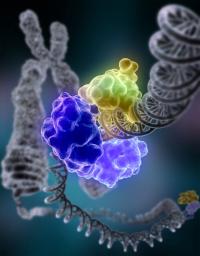
In this illustration, DNA ligase (in color) encircles the DNA double helix. Scientists investigating an important DNA-repair enzyme now have a better picture of the final steps of a process that glues together, or ligates, the ends of DNA strands to restore the double helix.
| Full story | 0 Comments | 5911 views |

| Health & Medicine | October 19, 2006 04:29 PM |
Orthopaedic surgery researchers at Washington University School of Medicine in St. Louis have identified yet another reason not to smoke. Studying rotator cuff injury in rats, the research team found exposure to nicotine delays tendon-to-bone healing, suggesting this could cause failure of rotator cuff repair following surgery in human patients.
| Full story | 0 Comments | 7150 views |
| Molecular & Cell Biology | October 19, 2006 02:29 PM |
New research from the University of Cincinnati (UC) suggests that the widely abused club drug "ecstasy," or MDMA, can increase the survival of dopamine cells in the brain during fetal development.
| Full story | 0 Comments | 5827 views |
| Microbiology | October 19, 2006 12:29 PM |
A new children's book from ASM Press uses the familiar genre of the ABC book to introduce readers to the not-so-familiar world of microbes. The Invisible ABCs will delight readers of all ages with its colorful presentation and spectacular selection of illustrations. Intended for school-age children and younger, this unique new book will stimulate parents, teachers, librarians, and even older students to discover the fascinating world of microorganisms.
| Full story | 0 Comments | 6281 views |
| Health & Medicine | October 19, 2006 10:29 AM |
In a finding that may provide a scientific basis for eventual treatment, neurology researchers have shown that traumatic brain injury reduces the level of a protein that helps keep brain activity in balance. The resulting abnormal activity, in turn, is thought to be an underlying reason for seizures and memory defects experienced by people who have suffered a traumatic brain injury (TBI).
| Full story | 1 Comment | 7050 views |

- In some genetic cases of microcephaly, stem cells fail to launch
- Yale team discovers how Zika virus causes fetal brain damage
- Scientists uncover the way a common cell enzyme alerts the body to invading bacteria
- Arctic gives clues on worst mass extinction of life
- Calcium channel blockers caught in the act at atomic level
Search Bio News Net
Free Biology Newsletter
- Flexibility That A.C.A. Lent to Work Force Is Threatened by...International Herald Tribune
- Bacteria Behind Legionnaires’ Disease Found at New York Police StationInternational Herald Tribune
- Prescription Price Crisis? 28 Million Americans See Spike in Drug...MSNBC.com: Health
- Seizing on Opioid Crisis, a Drug Maker Lobbies Hard for...International Herald Tribune
- Republicans are taking a big political risk on health careAP Health News
- Why We're So Divided Over Saving WolvesNational Geographic News