

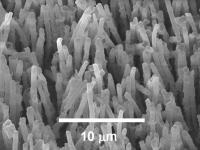
Scanning electron micrograph of an array of 20 micron long, 0.6
micron diameter polymer fibers. Scale bar represents 10 microns. Inspired by the remarkable hairs that allow geckos to hang single-toed from sheer walls and scamper along ceilings, a team of researchers led by engineers at the University of California, Berkeley, has created an array of synthetic micro-fibers that uses very high friction to support loads on smooth surfaces.

| Biotechnology | August 22, 2006 11:07 PM |
| Full story | 0 Comments | 7251 views |
| Biotechnology | August 22, 2006 10:07 PM |
Rice grown anywhere in the world soon could be made completely flood-tolerant because of new research by UC Riverside geneticists, done in collaboration with scientists at UC Davis and the International Rice Research Institute in the Philippines. By gradually introducing into California rice "submergence tolerance," a property that enables rice to survive extreme flood conditions, the researchers show how potentially any variety of rice could be made to survive short-term floods that completely submerge the rice plant – a result benefiting rice farmers worldwide.
| Full story | 0 Comments | 6345 views |

| Molecular & Cell Biology | August 22, 2006 08:53 PM |
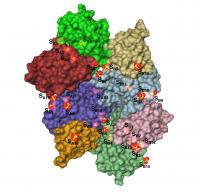
A surface representation of exopolyphosphatase, a protein with great potential as an antibiotic target. A Purdue University researcher has opened the door for possible antibiotic treatments for a variety of diseases by determining the structure of a protein that controls the starvation response of E. coli.
| Full story | 0 Comments | 6491 views |
| Molecular & Cell Biology | August 22, 2006 07:53 PM |
Researchers at the Board of Governors' Gene Therapeutics Research Institute at Cedars-Sinai Medical Center have confirmed the existence of anatomical structures that channel information exchanges between a T cell and its target, an antigen-presenting brain cell, in laboratory rats. This immunologic synapse, or junction where signals are shuttled between two immune cells, has previously only been observed in cell cultures, in part because of the limitations of imaging and the rapid, touch-and-go nature of the communication itself.
| Full story | 0 Comments | 8241 views |

| Biology | August 22, 2006 06:53 PM |
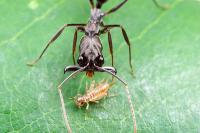
The trap-jaw ant, Odontomachus bauri, ready to strike. With peak velocities over 50 meters per second, their mandibles are among the fastest movements in the biological world.Berkeley -- A species of ant native to Central and South America is entering the annals of extreme animal movement, boasting jaws arguably more impressive than such noteworthy contenders as the great white shark and the spotted hyena.
| Full story | 0 Comments | 12961 views |
| Biology | August 22, 2006 04:53 PM |
In a finding that challenges a long-held belief regarding the cultural spread of tool use among chimpanzees, researchers report that chimpanzees in the Ebo forest, Cameroon, use stone hammers to crack open hard-shelled nuts to access the nutrient-rich seeds. The findings are significant because this nut-cracking behavior was previously known only in a distant chimpanzee population in extreme western Africa and was thought to be restricted by geographical boundaries that prevented cultural spread of the technique from animal to animal. The findings, which involve the most endangered and least-understood subspecies of chimpanzee, are reported by Dr. Bethan Morgan and Ekwoge Abwe of the Zoological Society of San Diego's Conservation and Research for Endangered Species (CRES) and appear in the August 22nd issue of the journal Current Biology, published by Cell Press.
| Full story | 0 Comments | 7450 views |
| Biology | August 22, 2006 02:53 PM |
In a finding that broadens our understanding of time perception in the animal kingdom, researchers have discovered that an insect pollinator, the bumble bee, can estimate the duration of time intervals. Although many insects show daily and annual rhythms of behavior, the more sophisticated ability to estimate the duration of shorter time intervals had previously been known only in humans and other vertebrates.
| Full story | 0 Comments | 7954 views |
| Molecular & Cell Biology | August 22, 2006 12:53 PM |
Dr. Ray Larsen is trying to learn a second language. The Bowling Green State University biologist wants to crack the communication code of proteins, especially the ones whose "talking" aids and abets disease.
| Full story | 0 Comments | 5755 views |

- In some genetic cases of microcephaly, stem cells fail to launch
- Yale team discovers how Zika virus causes fetal brain damage
- Scientists uncover the way a common cell enzyme alerts the body to invading bacteria
- Arctic gives clues on worst mass extinction of life
- Calcium channel blockers caught in the act at atomic level
Search Bio News Net
Free Biology Newsletter
- Flexibility That A.C.A. Lent to Work Force Is Threatened by...International Herald Tribune
- Bacteria Behind Legionnaires’ Disease Found at New York Police StationInternational Herald Tribune
- Prescription Price Crisis? 28 Million Americans See Spike in Drug...MSNBC.com: Health
- Seizing on Opioid Crisis, a Drug Maker Lobbies Hard for...International Herald Tribune
- Republicans are taking a big political risk on health careAP Health News
- Why We're So Divided Over Saving WolvesNational Geographic News