


Researchers at Karolinska Institutet have identified an important mechanism that regulates how many new cells are produced by each intestinal stem cell. The study is published in the latest issue of the prestigious scientific journal, Cell. "This might eventually help us develop new drugs for things like neurological disorders and anaemia," says Professor Jonas Frisén.

| Biology | June 16, 2006 09:42 PM |
In a study comparing wild rodents with their laboratory counterparts, researchers at Duke University Medical Center have found evidence that may help to explain why people in industrialized societies that greatly stress hygiene have higher rates of allergy and autoimmune diseases than do people in less developed societies in which hygiene is harder to achieve or considered less critical.
| Full story | 0 Comments | 4977 views |

| Microbiology | June 16, 2006 08:41 PM |
The cellular process of transcription, in which the enzyme RNA polymerase constructs chains of RNA from information contained in DNA, depends upon previously underappreciated sections of both the DNA promoter region and RNA polymerase, according to work done with the bacterium E. coli and published today (June 16) in the journal Cell by a team of bacteriologists from the University of Wisconsin-Madison.
| Full story | 0 Comments | 6335 views |

| Biotechnology | June 16, 2006 07:42 PM |
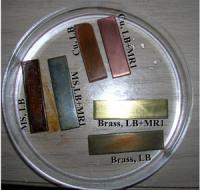
Exposed metal surfaces are highly vulnerable to corrosion, but paint or other protective coatings can interfere with some uses, as well as add significant costs. Now, a comprehensive series of experiments suggests a new form of protection: bacteria.
| Full story | 0 Comments | 6329 views |
| Biology | June 16, 2006 06:42 PM |
Vampire bats, the only mammals to feed exclusively on blood, including human blood, recognize their prey by the sound of its breathing. In a study published today in the open access journal BMC Biology, vampire bats of the species Desmodus rotondus could recognise recorded human breathing sounds much better than human participants could. Vampire bats feed on the same prey over several nights and the authors of the study propose that the bats use breathing sounds to identify their prey in the same way as humans use voice to recognise each other.
| Full story | 0 Comments | 10086 views |
| Microbiology | June 16, 2006 05:41 PM |
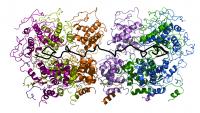
Six nucleoproteins (in different colours) bind side-by-side on one RNA molecule (black).Ebola, measles and rabies are serious threats to public health in developing countries. Despite different symptoms all of the diseases are caused by the same class of viruses that unlike most other living beings carry their genetic information on a single RNA molecule instead of a double strand of DNA. Now researchers from the Institut de Virologie Moléculaire et Structurale (IVMS) and the Outstation of the European Molecular Biology Laboratory (EMBL) in Grenoble have obtained a detailed structural picture of a protein that allows the rabies virus to withstand the human immune response and survive and replicate in our cells. The study that is published in this week's online edition of Science suggests new potential drug targets in rabies and sheds light on how similar approaches can help fighting other viral diseases.
| Full story | 0 Comments | 7564 views |
| Microbiology | June 16, 2006 02:28 PM |
Our skin not only serves as a physical barrier against infection but skin cells themselves can mount an immune response to kill invading microbes by producing antimicrobial polypeptides (AMPs).
| Full story | 0 Comments | 5816 views |

| Health & Medicine | June 16, 2006 10:28 AM |
Effector T cells (Teff cells) are involved in activating and directing other immune cells, while regulatory T cells (Tregs) act to curb the over-aggressive responses of the T cell population.
| Full story | 0 Comments | 5524 views |

- In some genetic cases of microcephaly, stem cells fail to launch
- Yale team discovers how Zika virus causes fetal brain damage
- Scientists uncover the way a common cell enzyme alerts the body to invading bacteria
- Arctic gives clues on worst mass extinction of life
- Calcium channel blockers caught in the act at atomic level
Search Bio News Net
Free Biology Newsletter
- Flexibility That A.C.A. Lent to Work Force Is Threatened by...International Herald Tribune
- Bacteria Behind Legionnaires’ Disease Found at New York Police StationInternational Herald Tribune
- Prescription Price Crisis? 28 Million Americans See Spike in Drug...MSNBC.com: Health
- Seizing on Opioid Crisis, a Drug Maker Lobbies Hard for...International Herald Tribune
- Republicans are taking a big political risk on health careAP Health News
- Why We're So Divided Over Saving WolvesNational Geographic News