

In a recent study, genetically modified cassava plants produced roots that were more than two-and-a-half times the size of normal cassava roots.

| Microbiology | May 24, 2006 10:27 PM |
Researchers have identified the genes in gum-disease bacteria that allow them to invade and infect human arterial cells, offering one possible explanation for a perceived connection between gum disease and heart disease. Scientists from the University of Florida, Gainesville, present their findings today at the 106th General Meeting of the American Society for Microbiology in Orlando, Florida.
| Full story | 0 Comments | 4807 views |
| Microbiology | May 24, 2006 09:27 PM |
Bacteria and fungi, some with the potential to cause disease in plants or animals, may be finding their way from Africa to the Americas by hitchhiking on microscopic dust particles kicked up by storms in the Sahara, according to research presented today at the 106th General Meeting of the American Society for Microbiology in Orlando, Florida.
| Full story | 0 Comments | 6446 views |

| Gene Therapy | May 24, 2006 06:16 PM |
Using one of the newest and most powerful tools of biomedical science, University of Texas Medical Branch at Galveston (UTMB) researchers have scored a dramatic success in the battle against colorectal cancer.
| Full story | 0 Comments | 7403 views |

| Biotechnology | May 24, 2006 05:16 PM |
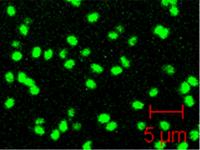
Microscope image of bacterial spores (Bacillus subtilis) labeled with luminescent carbon nanoparticles. B. subtilis serves as a common model for anthrax research. These carbon nanoparticles, or carbon dots, could lead...Chemists at Clemson University say they have developed a new type of quantum dot that is the first to be made from carbon. Like their metal-based counterparts, these nano-sized "carbon dots" glow brightly when exposed to light and show promise for a broad range of applications, including improved biological sensors, medical imaging devices and tiny light-emitting diodes (LEDs), the researchers say.
| Full story | 0 Comments | 5633 views |

| Molecular & Cell Biology | May 24, 2006 04:16 PM |
University of Minnesota researchers have found a group of cells in the intestinal system of mice that are proven to turn on T-cells, cells that help fight infection.
| Full story | 0 Comments | 3825 views |
| Biotechnology | May 24, 2006 03:16 PM |
By training a group of human subjects to operate a robot-controlled joystick, Johns Hopkins researchers have shown that the slower the brain "learns" to control certain muscle movements, the more likely it is to remember the lesson over the long haul. The results, the investigators say, could alter rehabilitation approaches for people who have lost motor abilities to brain injuries like strokes.
| Full story | 0 Comments | 4654 views |

| Health & Medicine | May 24, 2006 02:16 PM |
The field of vaccine development is getting a boost from new research that has identified a promising vaccine delivery approach, which in animal studies produced long-term immune protection after just one immunization. University of Pittsburgh researchers, who report their findings in the journal Immunity, say the method has particular relevance for efforts aimed at preventing or controlling infectious diseases, such as HIV or influenza, or stopping the growth of cancer. In one set of studies using this delivery approach, a single immunization halted the progression of melanoma and significantly extended survival in a mouse model.
| Full story | 0 Comments | 4273 views |
| Molecular & Cell Biology | May 24, 2006 01:16 PM |
Whether or not a fertilized mammalian egg ultimately develops into a male or female is determined by the winner of a tug of war between two different genes encoding signaling proteins and the divergent pathways they control, according to a new study led by Duke University Medical Center cell biologists.
| Full story | 0 Comments | 6384 views |
| Health & Medicine | May 24, 2006 12:16 PM |
Researchers at Montefiore Medical Center are leading a nationwide clinical trial to determine whether a new genetic test can be used to personalize treatment for early-stage breast cancer.
| Full story | 0 Comments | 6776 views |
| Molecular & Cell Biology | May 24, 2006 11:16 AM |
Selenium, an essential dietary mineral that can act as an antioxidant when incorporated into proteins, has been shown in many studies to reduce the incidence of cancers -- notably lung, colorectal and prostate.
| Full story | 0 Comments | 4344 views |
| Microbiology | May 24, 2006 10:16 AM |
Orange juice and other foods traditionally not associated with foodborne disease outbreaks can still be a source of disease, although rare. Public health officials should be aware of this possibility and on guard, say scientists presenting today at the 106th General Meeting of the American Society for Microbiology (ASM) in Orlando, Florida. "The more we find out about the behavior of microorganisms in non-potentially hazardous foods the more we are beginning to understand that some of these foods are borderline or not consistent with the definition," says Dr. Larry Beuchat of Center for Food Safety at the University of Georgia. Foods that, because their acidity, moisture level, or a combination of both, are incapable of supporting the growth of foodborne pathogens or toxin production without storage time and temperature controls are defined by the U.S. Food Code as non-potentially hazardous foods. But this designation also includes foods that do not support growth but still may contain pathogenic organisms at sufficient levels to cause disease.
| Full story | 3 Comments | 8005 views |

- In some genetic cases of microcephaly, stem cells fail to launch
- Yale team discovers how Zika virus causes fetal brain damage
- Scientists uncover the way a common cell enzyme alerts the body to invading bacteria
- Arctic gives clues on worst mass extinction of life
- Calcium channel blockers caught in the act at atomic level
Search Bio News Net
Free Biology Newsletter
- Flexibility That A.C.A. Lent to Work Force Is Threatened by...International Herald Tribune
- Bacteria Behind Legionnaires’ Disease Found at New York Police StationInternational Herald Tribune
- Prescription Price Crisis? 28 Million Americans See Spike in Drug...MSNBC.com: Health
- Seizing on Opioid Crisis, a Drug Maker Lobbies Hard for...International Herald Tribune
- Republicans are taking a big political risk on health careAP Health News
- Why We're So Divided Over Saving WolvesNational Geographic News