


A new study reveals how the production of a potent immune regulator called interferon gamma (IFNg) is controlled in natural killer (NK) cells, immune cells that typically defend the body against cancer and infections.

| Bioinformatics | May 23, 2006 11:36 PM |
Microbes, thriving in even the world's most extreme environments, are capable of performing myriad biological functions, learned over the billions of years they have inhabited the planet. Those lessons, and how they can be captured to render clean renewable sources of energy and to repair damaged environments, are among the many secrets encoded in their DNA sequence. On May 23, at the general meeting of the American Society of Microbiology (ASM), the U.S. Department of Energy Joint Genome Institute (DOE JGI) will announce that it has finished the sequence of100 microbial genomes and released this information for the benefit of the global research community.
| Full story | 0 Comments | 9050 views |

| Biotechnology | May 23, 2006 11:26 PM |
An MIT poet has developed a small, relatively inexpensive "seeing machine" that can allow people who are blind, or visually challenged like her, to access the Internet, view the face of a friend, "previsit" unfamiliar buildings and more.
| Full story | 0 Comments | 4011 views |

| Biology | May 23, 2006 11:02 PM |
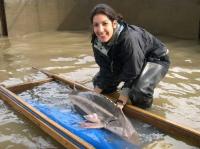
Dr. Phaedra Doukakis of Rosenstiel School's Pew Institute for Ocean
Science with one of the studied sturgeon. Scientists working in the Ural River, Kazakhstan, have successfully attached Pop-up Archival Transmitting (PAT) tags to four sturgeons and have released the animals into the Caspian Sea, hoping to get a clear picture of Caspian Sea sturgeon movement and behavior never before available.
| Full story | 0 Comments | 6706 views |
| Biology | May 23, 2006 07:26 PM |
Their journeys are among the longest in the animal kingdom and they have largely remained a mystery until now. An international team of scientists led by the University of Exeter have uncovered the migratory secrets of endangered loggerhead turtles in West Africa and the results could have huge implications for strategies to protect them.
| Full story | 0 Comments | 5730 views |
| Biology | May 23, 2006 06:26 PM |
From May 22-30, Harbor Branch scientists, along with colleagues from the University of Miami, will use the Harbor Branch Johnson-Sea-Link II submersible to explore for the first time newly discovered deep-sea reefs between Florida and the Bahamas. The reefs were discovered in 2,000 to 2,900 feet of water last December by a University of Miami team using advanced sonar techniques. A primary goal of the upcoming expedition, which is funded largely by the State of Florida's "Florida Oceans Initiative," will be to search for marine organisms that produce chemical compounds with the potential to treat human diseases such as cancer and Alzheimer's.
| Full story | 0 Comments | 4098 views |

| Health & Medicine | May 23, 2006 05:26 PM |
High-dose influenza vaccines may increase elderly patients' immune response without significant adverse effects, offering this vulnerable population additional protection against the flu, according to an article in the May 22 issue of Archives of Internal Medicine, one of the JAMA/Archives journals.
| Full story | 0 Comments | 4670 views |
| Health & Medicine | May 23, 2006 04:26 PM |
Cocoa butter has long been used topically in many skin creams and cosmetics because it is thought to be good for the skin. Now, new research just published in the Journal of Nutrition reveals the potential benefits of consuming flavanol-rich cocoa and how it might actually benefit skin from the inside out.
| Full story | 1 Comment | 7250 views |
| Health & Medicine | May 23, 2006 03:26 PM |
While public attention gravitates towards conflict and natural disaster, many people in countries less affected by such events struggle with some of the same nutrition problems as those in crisis. In a "Viewpoint" published in The Lancet, Rainer Gross, PhD, UNICEF's chief of nutrition, and Patrick Webb, PhD, dean for academic affairs at the Friedman School of Nutrition Science and Policy at Tufts University, discuss five facts about world hunger, children and wasting, a condition that represents severe malnutrition.
| Full story | 0 Comments | 5470 views |

| Gene Therapy | May 23, 2006 02:26 PM |
University of Florida scientists have delivered a gene through an eggshell to give sight to a type of chicken normally born blind.
| Full story | 0 Comments | 5066 views |

| Environment | May 23, 2006 01:26 PM |
The Brazilian government has created an official buffer zone around the Abrolhos National Marine Park to protect the biologically richest coral reefs in the South Atlantic.
| Full story | 0 Comments | 8261 views |
| Biology | May 23, 2006 12:26 PM |
Last December, University of Miami Rosenstiel School of Marine and Atmospheric Science researchers using advanced sonar techniques discovered new deepwater reef sites in the Straits of Florida between Miami and Bimini. Today through May 30, the Rosenstiel School scientists will work with Harbor Branch Oceanographic Institution colleagues to explore these areas for the first time. The expedition, which will rely on Harbor Branch's Johnson-Se-Link II submersible, will search for and collect marine organism samples from these new reefs in 2,000-2,900 feet of water to determine which produce chemicals with the potential to treat human diseases such as cancer or Alzheimer's disease. The State of Florida's "Florida Oceans Initiative" is the primary project funder.
| Full story | 0 Comments | 5220 views |
| Biology | May 23, 2006 11:26 AM |
Ecologists have at last got a view of sperm whales' behaviour during their long, deep dives, thanks to the use of recently developed electronic "dtags". According to new research published in the British Ecological Society's Journal of Animal Ecology, sperm whales – like bats – use echolocation consistently to track down their prey at depth.
| Full story | 0 Comments | 6079 views |
| Biology | May 23, 2006 10:26 AM |
When ancient whales finally parted company with the last remnants of their legs about 35 million years ago, a relatively sudden genetic event may have crowned an eons-long shrinking process.
| Full story | 0 Comments | 5581 views |

- In some genetic cases of microcephaly, stem cells fail to launch
- Yale team discovers how Zika virus causes fetal brain damage
- Scientists uncover the way a common cell enzyme alerts the body to invading bacteria
- Arctic gives clues on worst mass extinction of life
- Calcium channel blockers caught in the act at atomic level
Search Bio News Net
Free Biology Newsletter
- Flexibility That A.C.A. Lent to Work Force Is Threatened by...International Herald Tribune
- Bacteria Behind Legionnaires’ Disease Found at New York Police StationInternational Herald Tribune
- Prescription Price Crisis? 28 Million Americans See Spike in Drug...MSNBC.com: Health
- Seizing on Opioid Crisis, a Drug Maker Lobbies Hard for...International Herald Tribune
- Republicans are taking a big political risk on health careAP Health News
- Why We're So Divided Over Saving WolvesNational Geographic News