

Individual variation in social behavior is one of the most striking features of cooperative animal societies. In a new study from the June issue of American Naturalist, Michael A. Cant (University of Cambridge), Justine B. Llop (University of Cambridge), and Jeremy Field (University College London) investigate the extent to which differences in aggressive behavior within a cooperative society can be explained by "inheritance rank"--the likelihood that an individual will get to mate successfully in that society based on their rank--or place in the social hierarchy. They can only pass on their genes when they reach the top of the hierarchy, usually after those ahead of them in the rank have died and they have inherited the right to reproduce.

| Environment | May 10, 2006 09:43 PM |
Arctic climate already is known to be particularly prone to global warming caused by industrial and automotive emissions of carbon dioxide and other greenhouse gases. Now, a University of Utah study finds a surprising new way society's pollutants warm the far north: the Arctic's well-known haze – made of particulate pollution from mid-latitude cities – mixes with thin clouds, making them better able to trap heat.
| Full story | 0 Comments | 6625 views |

| Biology | May 10, 2006 08:43 PM |
Plant and animal breeders have long used hybridization to transfer useful traits between species. But does the same process happen without human aid? In a new study in the June issue of American Naturalist, Kenneth D. Whitney (Indiana University and Rice University), Rebecca A. Randell (Indiana University), and Loren H. Rieseberg (Indiana University), explore how spontaneous hybridization – known as adaptive trait introgression – has a vital impact on adaptation and evolutionary diversification.
| Full story | 0 Comments | 7594 views |
| Biology | May 10, 2006 07:43 PM |
Scientists at UCL (University College London) have discovered that even wasps are driven by their status. The study, published today in Nature, shows that lower-ranked female wasps work harder to help their queen than those higher up the chain because they have less to lose, and consequently are prepared to take more risks and wear themselves out.
| Full story | 0 Comments | 5130 views |

| AIDS & HIV | May 10, 2006 06:43 PM |
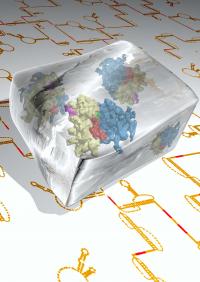
Mammalian ribosomes caught in the process of frameshifting. The ice block symbolizes the cryo-electron microscopy used to image the ribosomes.UK scientists have cracked one of the key biological processes used by viruses such as HIV and SARS when they replicate according to a paper published in the journal Nature tomorrow (11 May). Viruses are able to interfere with the host cell processes that our bodies use to replicate cells, and protein synthesis is often one of their targets. For the first time, researchers at the Universities of Cambridge and Oxford have witnessed virus-induced "frameshifting" in action and have been able to identify the crucial role of particular elements.
| Full story | 0 Comments | 6494 views |

| Microbiology | May 10, 2006 04:17 PM |
Don't even think about trying to pronounce it. Although it is found in many organisms including humans, glycosylphosphatidylinositol has remained a mouthful for laymen and a puzzle for scientists. And yet GPIs, as science thankfully calls these cellular lipids, are important in numerous biological functions, including disease transmission.
| Full story | 0 Comments | 5371 views |

| Bioinformatics | May 10, 2006 02:17 PM |
Researchers at New York University's Courant Institute of Mathematical Sciences have developed a new algorithm that enhances the ability to detect a cancer gene, and have applied their algorithm to map the set of tumor-suppressor genes involved in lung cancer. The algorithm uses data from Affymetrix's gene-chips that can scan hundreds of patients' genomes to find gains and losses in gene-copies. The findings will appear in the July issue of the American Journal of Human Genetics.
| Full story | 0 Comments | 6492 views |
| Biology | May 10, 2006 12:17 PM |
A new method to calculate the transfer of nitrogen from Arctic mushrooms to plants is shedding light on how fungi living symbiotically on plant roots transfer vital nutrients to their hosts. The analytical technique, developed by John E. Hobbie, MBL Distinguished Scientist and co-director of the laboratory's Ecosystems Center and his son, Erik A. Hobbie of the University of New Hampshire, may be applied to nearly all conifers, oaks, beeches, birch and shrubs such as blueberry and cranberry--all nitrogen-poor ecosystems--and will be an important tool for future studies of plant nitrogen supply.
| Full story | 0 Comments | 7650 views |

| Molecular & Cell Biology | May 10, 2006 10:16 AM |
A new way to preserve the cells that surround and protect nerves could lead to new treatments for demyelinating diseases such a multiple sclerosis, a research team reports in the May 10, 2006, issue of the Journal of Neuroscience.
| Full story | 0 Comments | 5180 views |

- In some genetic cases of microcephaly, stem cells fail to launch
- Yale team discovers how Zika virus causes fetal brain damage
- Scientists uncover the way a common cell enzyme alerts the body to invading bacteria
- Arctic gives clues on worst mass extinction of life
- Calcium channel blockers caught in the act at atomic level
Search Bio News Net
Free Biology Newsletter
- Flexibility That A.C.A. Lent to Work Force Is Threatened by...International Herald Tribune
- Bacteria Behind Legionnaires’ Disease Found at New York Police StationInternational Herald Tribune
- Prescription Price Crisis? 28 Million Americans See Spike in Drug...MSNBC.com: Health
- Seizing on Opioid Crisis, a Drug Maker Lobbies Hard for...International Herald Tribune
- Republicans are taking a big political risk on health careAP Health News
- Why We're So Divided Over Saving WolvesNational Geographic News