

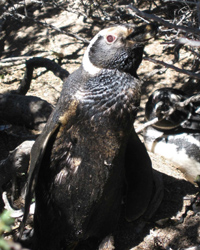
An oiled penguin along Argentina's Atlantic coast in October 2005. Photo by Dee Boersma The old adage tells that oil doesn't mix with water. It doesn't do much for creatures in the water either, as demonstrated by new research on the effects of water-borne oil on seabirds along the Atlantic Coast in Brazil, Uruguay and Argentina.

| Environment | February 1, 2006 06:13 PM |
| Full story | 0 Comments | 7552 views |

| Biology | February 1, 2006 06:13 PM |

Marmoset monkeys play with and groom one another in a marmoset monkey colony display in the lobby of the National Primate Research Center. A red tag indicates a female monkey of breeding age and a blue indicates a male monkey of breeding age. Photo by Jeff Miller, March 2005. Confirming what many have long suspected, scientists have found that male monkeys of two different species get heavier when their mates are pregnant.
| Full story | 0 Comments | 4688 views |

| Biotechnology | February 1, 2006 06:13 PM |
British researchers have developed a "biobullet" that could help control an invasive mollusk that has ravaged U.S. waterways for nearly two decades clogging water pipes, virtually wiping out some native mussels species and causing billions of dollars in industrial damage. The new microcapsules, which contain toxins that dissolve within a zebra mussel's digestive tract, offer a safe and cost-effective way of eliminating one of the world's "most important economic pests" without harming other aquatic life, according to scientists at the University of Cambridge.
| Full story | 0 Comments | 6316 views |

| Molecular & Cell Biology | February 1, 2006 06:12 PM |
Researchers worldwide are seeking to define ancient sections of our genetic code that may soon be as important to medical science as genes. A new wave of research is concerned with, not how genes work, but how small regulatory DNA sequences tell genes where, when and to what degree to "turn on." As part of this effort, researchers at the University of Rochester Medical Center scanned through the vast human DNA code to reveal for the first time 60 genes influenced by one such sequence, according to an article published today in the journal Genome Research.
| Full story | 0 Comments | 4186 views |

| Microbiology | February 1, 2006 06:12 PM |
Bacterial infections can strike anyone, and they can sometimes be fatal. Because more and more bacteria are becoming resistant to the pre-eminent remedy; antibiotics; the search for new remedies against bacterial infections is in high gear. Research by scientists from the Flanders Interuniversity Institute for Biotechnology (VIB) connected to Ghent University shows that certain mice, by nature, can withstand particular bacterial infections. Elucidation of the biological process that underlies this natural ability offers perspectives for the development of new therapeutics.
| Full story | 0 Comments | 4572 views |
| Molecular & Cell Biology | February 1, 2006 06:12 PM |
This protein was previously thought to play a role solely in the innate immune system's response to bacterial infection. In the new study, which will be published on-line by the Proceedings of the National Academy of Sciences of the United States of America on January 23, researchers showed for the first time that the protein, which is present in epithelial cells of the intestinal tract and lungs, is linked to the control of malignant cell growth.
| Full story | 0 Comments | 5355 views |
| Biotechnology | February 1, 2006 06:11 PM |
The next generation of artificial bone may rely on a few secrets from the sea. Scientists from the U.S. Department of Energy's Lawrence Berkeley National Laboratory (Berkeley Lab) have harnessed the way seawater freezes to develop a porous, scaffolding-like material that is four times stronger than material currently used in synthetic bone.
| Full story | 0 Comments | 4781 views |
| Biology | February 1, 2006 06:10 PM |
UCLA paleobiologist J. William Schopf and colleagues have produced 3-D images of ancient fossils -- 650 million to 850 million years old -- preserved in rocks, an achievement that has never been done before.
| Full story | 0 Comments | 4562 views |

| Microarray | February 1, 2006 06:08 PM |
Scientists have discovered that a wide variety of different cancers actually share something in common – a molecular "signature" made up of tiny bits of genetic material called microRNA (miRNA) that target key cancer genes and promote malignant growth.
| Full story | 0 Comments | 6475 views |

- In some genetic cases of microcephaly, stem cells fail to launch
- Yale team discovers how Zika virus causes fetal brain damage
- Scientists uncover the way a common cell enzyme alerts the body to invading bacteria
- Arctic gives clues on worst mass extinction of life
- Calcium channel blockers caught in the act at atomic level
Search Bio News Net
Free Biology Newsletter
- Flexibility That A.C.A. Lent to Work Force Is Threatened by...International Herald Tribune
- Bacteria Behind Legionnaires’ Disease Found at New York Police StationInternational Herald Tribune
- Prescription Price Crisis? 28 Million Americans See Spike in Drug...MSNBC.com: Health
- Seizing on Opioid Crisis, a Drug Maker Lobbies Hard for...International Herald Tribune
- Republicans are taking a big political risk on health careAP Health News
- Why We're So Divided Over Saving WolvesNational Geographic News