

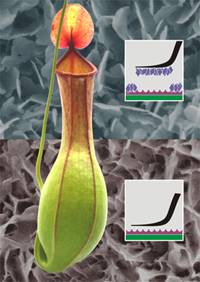
The pitfall trap of the pitcher plant Nepenthes alata. Background: the image from a scanning electron microscope of the upper and lower wax layers. The diagrams show how the two wax layers reduce the adhesive ability of insects. The upper layer contaminates the insects' adhesive pads, whereas the lower layer decreases the amount of contact between the adhesive hairs of the foot and the substrate. Image: Max Planck Institute for Metals ResearchPlants are able, using organic substances, to achieve effects that we otherwise mostly know only from technical materials. One example of this is the carnivorous pitcher plant, as researchers from the Max Planck Institute for Metals Research and the University of Hohenheim have shown. These plants catch insects and hold them using traps with a double layer of crystalline wax. The upper layer has crystalloids which contaminate the attachment organs that insects use to adhere themselves to surfaces. The lower layer additionally reduces the contact area between the insect feet and plant surface. The insects thus slip into the pitcher-shaped traps, where they are digested (The Journal of Experimental Biology, December 2005). These results provide ideas for further developments of technological anti-adhesive surfaces.

| Biology | January 14, 2006 10:03 PM |
| Full story | 1 Comment | 9076 views |

| Bioinformatics | January 14, 2006 10:03 PM |
A pig used for research at the University of Illinois atUrbana-Champaign has a home in history. Its DNA will provide the first sequence of the swine genome to be completed with the help of a two-year $10 million grant from the U.S. Department of Agriculture announced today (Jan. 13) by Agriculture Secretary Mike Johanns.
| Full story | 0 Comments | 5388 views |

| Biotechnology | January 14, 2006 10:03 PM |
Researchers at The University of Texas M. D. Anderson Cancer Center say they have jumped a significant hurdle in the use of RNA interference (RNAi), believed by many to be the ultimate tool to both decode the function of individual genes in the human genome and to treat disease.
| Full story | 0 Comments | 4728 views |

| Health & Medicine | January 14, 2006 10:02 PM |
Individuals who have a rare genetic immune system disorder that prevents them from making antibodies nevertheless appear to be moderately healthy and lead productive lives, according to results of a study by investigators at St. Jude Children's Research Hospital. A report on this study appears in the current online edition of Clinical Immunology.
| Full story | 0 Comments | 4836 views |
| Health & Medicine | January 14, 2006 10:02 PM |
The flu hasn't even hit hard yet this year, but it seems like everyone's getting sick. What's the deal?
| Full story | 0 Comments | 4994 views |

| Microbiology | January 14, 2006 10:02 PM |
Researchers at Erasmus Medical Center have demonstrated systemic spread of avian influenza virus in cats infected by respiratory, digestive, and cat-to-cat contact. The paper by Rimmelzwaan et al., "Influenza A virus (H5N1) infection in cats causes systemic disease with potential novel routes of virus spread within and between hosts," appears in the January issue of The American Journal of Pathology and is accompanied by a commentary.
| Full story | 0 Comments | 7237 views |

| Molecular & Cell Biology | January 14, 2006 09:51 PM |
A quarter century after they discovered it, researchers have identified the job of one of the most common DNA-damage response proteins. The enzyme has puzzled scientists because it is present in nearly every organism, which suggests that it is crucial to life, and yet, in laboratory experiments, its function has remained a mystery.
| Full story | 0 Comments | 5706 views |

| Environment | January 14, 2006 09:50 PM |
A new report that links global warming to the recent extinction of dozens of amphibian species in tropical America is more evidence of a large phenomena that may affect broad regions, many animal species and ultimately humans, according to researchers at Oregon State University.
| Full story | 0 Comments | 6797 views |
| Bioinformatics | January 14, 2006 09:50 PM |
A new method to mine existing scientific data may provide a wealth of information about the interactions among genes, the environment and biological processes, say researchers at the Stanford University School of Medicine, Lucile Packard Children's Hospital and Harvard Medical School. Like panning for gold, they used the powerful technique to sift through millions of bits of unrelated information - in this case, gene expression data from so-called microarray experiments - to pinpoint genes likely to be involved in leukemia, aging, injury and muscle development.
| Full story | 0 Comments | 11801 views |

- In some genetic cases of microcephaly, stem cells fail to launch
- Yale team discovers how Zika virus causes fetal brain damage
- Scientists uncover the way a common cell enzyme alerts the body to invading bacteria
- Arctic gives clues on worst mass extinction of life
- Calcium channel blockers caught in the act at atomic level
Search Bio News Net
Free Biology Newsletter
- Flexibility That A.C.A. Lent to Work Force Is Threatened by...International Herald Tribune
- Bacteria Behind Legionnaires’ Disease Found at New York Police StationInternational Herald Tribune
- Prescription Price Crisis? 28 Million Americans See Spike in Drug...MSNBC.com: Health
- Seizing on Opioid Crisis, a Drug Maker Lobbies Hard for...International Herald Tribune
- Republicans are taking a big political risk on health careAP Health News
- Why We're So Divided Over Saving WolvesNational Geographic News