

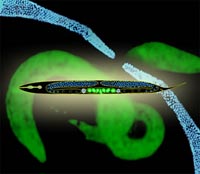
C. elegans is less than a millimeter in length and completely transparent. In the hermaphrodite, sex-cell division takes place within the tubelike arms of the gonad. As cell nuclei move through them, every stage of meiosis can be observed under the microscope. Most cells in the body contain two copies of every chromosome, one from each parent. Sex involves gently scrambling the genetic material of the chromosomes to produce variations within each species, creating individuals variously equipped to meet life's challenges. The secret of sex is meiosis, a specialized kind of cell division in which a cell replicates and then divides twice (not just once, as nonsex cells do), resulting in sperm or eggs with just one set of chromosomes each.

| Molecular & Cell Biology | December 15, 2005 10:26 PM |
| Full story | 0 Comments | 11698 views |

| Biology | December 15, 2005 10:26 PM |
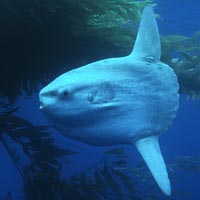
Studying fish, like this ocean sulfish, scientists are revealing the link between evolution and a species' genome. (Photo courtesy: Earthwindow.com/Mike Johnson)Biologists at Georgia Tech have provided scientific support for a controversial hypothesis that has divided the fields of evolutionary genomics and evolutionary developmental biology, popularly known as evo devo, for two years. Appearing in the December 2005 issue of Trends in Genetics, researchers find that the size and complexity of a species' genome is not an evolutionary adaptation per se, but can result as simply a consequence of a reduction in a species' effective population size.
| Full story | 0 Comments | 6941 views |

| Microbiology | December 15, 2005 10:26 PM |
The ubiquitous and usually harmless E. coli bacterium, which has one-seventh the number of genes as a human, has more than 1,000 of them involved in metabolism and metabolic regulation. Activation of random combinations of these genes would theoretically be capable of generating a huge variety of internal states; however, researchers at UCSD will report in the Dec. 27 issue of Proceedings of the National Academy of Sciences (PNAS) that Escherichia coli doesn't gamble with its metabolism.
| Full story | 0 Comments | 7317 views |
| Biology | December 15, 2005 10:25 PM |
Bats have an "ear" for flying in the dark because of a remarkable auditory talent that allows them to determine their physical environment by listening to echoes. But an Ohio University neurobiology professor says bats have a "feel" for it, too.
| Full story | 0 Comments | 6883 views |

| Biotechnology | December 15, 2005 10:25 PM |
Ohio State University researchers have invented a process for uncoiling long strands of DNA and forming them into precise patterns.
| Full story | 0 Comments | 6186 views |

| Bioinformatics | December 15, 2005 10:25 PM |
Through the Human Genome Project, the HapMap Project and other efforts, we are beginning to identify genes that are modified in some diseases. More difficult to measure and identify are the regulatory regions in DNA – the 'managers' of genes – that control gene activity and might be important in causing disease.
| Full story | 0 Comments | 8335 views |
| Biology | December 15, 2005 10:25 PM |
The brain's ability to reorganize itself - strengthening or weakening connections between neurons or adding or subtracting those connections - allows it to form memories, make transitions between sleep and waking, and focus attention on objects of interest.
| Full story | 0 Comments | 6656 views |
| Microbiology | December 15, 2005 10:25 PM |
New research by a team of scientists in France and the United States has identified both the bacterial and host receptor proteins that enable Rickettsia conorii, the Mediterranean spotted fever pathogen, to enter cells. Understanding how this bacterium interacts with the cells of its host could lead to new therapeutic strategies for diseases caused by related pathogens, including Rocky Mountain spotted fever and typhus.
| Full story | 0 Comments | 5429 views |

| Environment | December 15, 2005 10:25 PM |
Buoyed by the effects of an intense drought, otherwise harmless snails likely killed off thousands of acres of salt marsh in the Southeast in recent years.
| Full story | 0 Comments | 4930 views |

- In some genetic cases of microcephaly, stem cells fail to launch
- Yale team discovers how Zika virus causes fetal brain damage
- Scientists uncover the way a common cell enzyme alerts the body to invading bacteria
- Arctic gives clues on worst mass extinction of life
- Calcium channel blockers caught in the act at atomic level
Search Bio News Net
Free Biology Newsletter
- Flexibility That A.C.A. Lent to Work Force Is Threatened by...International Herald Tribune
- Bacteria Behind Legionnaires’ Disease Found at New York Police StationInternational Herald Tribune
- Prescription Price Crisis? 28 Million Americans See Spike in Drug...MSNBC.com: Health
- Seizing on Opioid Crisis, a Drug Maker Lobbies Hard for...International Herald Tribune
- Republicans are taking a big political risk on health careAP Health News
- Why We're So Divided Over Saving WolvesNational Geographic News