

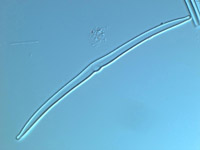
Newly discovered diatom Hannaea superiorensis, the only known Hannaea diatom native to Lake Superior. Credit: Photo by Mark Edlund.Lake Superior has a new native resident. It's been hanging around the shore for years, but until now it was regarded as an intercontinental drifter, not a homegrown local. So say Rebecca Bixby of the University of Georgia and fellow researchers Mark Edlund of the Science Museum of Minnesota and Eugene Stoermer from the University of Michigan. In the latest issue of Diatom Research, the scientists describe a new species of diatom, Hannaea superiorensis, found primarily in Lake Superior. Prior to its discovery, the new species of photosynthetic algae was combined with another group of diatoms found in cold, pristine rivers and streams around the world. This is now the only described species of the genus Hannaea that has adapted to living in a lake environment and inhabits one lake in particular.

| Microbiology | December 4, 2005 10:45 PM |
| Full story | 0 Comments | 6279 views |

| Biotechnology | December 4, 2005 10:45 PM |
Breeding rice with higher levels of iron can have an important impact on reducing micronutrient malnutrition, according to a new study in the Journal of Nutrition. The research, conducted by scientists from the Philippines and the United States, is a major step forward in the battle against iron deficiency, one of the developing world's most debilitating and intractable public health problems affecting nearly 2 billion people.
| Full story | 0 Comments | 5262 views |

| Environment | December 4, 2005 10:45 PM |
Against the backdrop of the Montreal Summit on global climate being held this week, an article on African droughts and monsoons, by a University of California, Santa Barbara scientist and others, which appears in the December issue of the journal Geology, underlines concern about the effects of global climate change.
| Full story | 0 Comments | 4734 views |

| Molecular & Cell Biology | December 4, 2005 10:45 PM |
Muscle in adults is constantly being built and broken down. As young adults we keep the two processes in balance, but when we age breakdown starts to win. However, adding the amino acid leucine to the diet of old individuals can set things straight again. This is the finding of research performed by Lydie Combaret, Dominique Dardevet and colleagues at the Human Nutrition Research Centre of Auvergne, INRA, Clermont-Ferrand, France.
| Full story | 0 Comments | 5325 views |

| Biology | December 4, 2005 10:45 PM |
Placing your foot accurately is a complicated process. If something moves where you plan to place your foot then you can adjust your step while your foot is swinging through. Experts thought previously that if nothing changed in the path, or in your plans, then the place where your foot will land is fixed before it even leaves the ground. In this case, you would make no use of immediate visual information during each step.
| Full story | 0 Comments | 4468 views |
| Molecular & Cell Biology | December 4, 2005 10:45 PM |
Mitochondria are the cell's equivalent of power stations. A power station burns fuel to build up steam pressure and uses that pressure to drive a turbine linked to a dynamo. This in turn generates electricity. In mitochondria, the fuel is oxidised and builds up a pressure of hydrogen ions (protons). These force through molecular turbines and enable the cell to generate ATP, an energy unit that can be used throughout the cell.
| Full story | 0 Comments | 6124 views |

| Bioinformatics | December 4, 2005 10:44 PM |
Take a pot of scalding water, remove all the oxygen, mix in a bit of poisonous carbon monoxide, and add a pinch of hydrogen gas. It sounds like a recipe for a witch's brew. It may be, but it is also the preferred environment for a microbe known as Carboxydothermus hydrogenoformans.
| Full story | 0 Comments | 6972 views |
| Biology | December 4, 2005 10:44 PM |
Memory formation follows a dynamic pattern, allowing for retrieval from different areas of the brain, depending on when an organism needs to remember, said a researcher at Baylor College of Medicine.
| Full story | 0 Comments | 5193 views |
| Molecular & Cell Biology | December 4, 2005 10:44 PM |
Using a new form of microscopy to penetrate living lymph nodes, UCSF scientists have for the first time viewed immune cells at work, helping clarify how T cells control autoimmunity.
| Full story | 0 Comments | 4848 views |

| Health & Medicine | December 4, 2005 10:44 PM |
New imaging research at UCLA detailed Dec. 4 as an advance online publication of the journal Nature Neuroscience shows children with autism have virtually no activity in a key part of the brain's mirror neuron system while imitating and observing emotions.
| Full story | 0 Comments | 5962 views |

- In some genetic cases of microcephaly, stem cells fail to launch
- Yale team discovers how Zika virus causes fetal brain damage
- Scientists uncover the way a common cell enzyme alerts the body to invading bacteria
- Arctic gives clues on worst mass extinction of life
- Calcium channel blockers caught in the act at atomic level
Search Bio News Net
Free Biology Newsletter
- Flexibility That A.C.A. Lent to Work Force Is Threatened by...International Herald Tribune
- Bacteria Behind Legionnaires’ Disease Found at New York Police StationInternational Herald Tribune
- Prescription Price Crisis? 28 Million Americans See Spike in Drug...MSNBC.com: Health
- Seizing on Opioid Crisis, a Drug Maker Lobbies Hard for...International Herald Tribune
- Republicans are taking a big political risk on health careAP Health News
- Why We're So Divided Over Saving WolvesNational Geographic News