

They're but a tiny speck, existing in a variety of forms: particles, tubes, shells, even a soccerball-like shape. They also share a common prefix: "nano," connoting their size, a billionth of a meter or roughly 25-millionth of an inch.

| Biotechnology | November 18, 2005 09:31 PM |
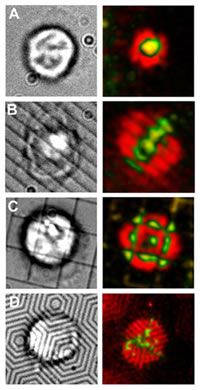
These fluorescently labeled electron micrographs show immunological synapses formed by T cell receptors (green) and adhesion molecules (red). Image (A) shows the synapse in its natural bull’s eye shape; in image (B) chromium lines were used to pattern the synapse with parallel lines; (C) the synapse was patterned into a square grid; and (D), the synapse was patterned into concentric hexagons.
An experiment that began as a "fantasy pipe dream" just three years ago is now a reality. Researchers with the Lawrence Berkeley National Laboratory (Berkeley Lab) and the University of California at Berkeley, combining nanotechnology with biochemistry, have created unique synthetic membranes that, for the first time ever, enable them to directly control signaling activity in living T cells from the immune system. Already their experiments have yielded surprising results.
| Full story | 0 Comments | 4420 views |

| Molecular & Cell Biology | November 18, 2005 09:31 PM |
The immune system is highly complex. The cast of characters alone required to marshal an immune response to a foreign invader can number in the millions as the body's soldiers, T cells, are called into action. What triggers this complex response begins when T cells and dendritic cells, another type of immune cell, form a kind of molecular embrace, or immunological synapse, to relay information about intruders.
| Full story | 0 Comments | 4638 views |

| Health & Medicine | November 18, 2005 09:30 PM |
A Scots-led medical research team has identified a new gene linked to major mental illness that links back to a previously discovered gene known to increase the risk of schizophrenia and depression. Scientists from the Universities of Edinburgh and Glasgow, together with scientists from the pharmaceutical company Merck, Sharp & Dohme Limited, report the discovery of the second gene, phosphodiesterase 4B (PDE4B) in the prestigious journal Science today (17 November). Their discoveries could lead to the eventual development of new drugs to treat mental health problems.
| Full story | 0 Comments | 5214 views |

| Biology | November 18, 2005 09:30 PM |
Max Planck researchers in Cologne, Germany demonstrate that a multi-step defence system underlies the durable resistance of plants to fungal parasitesPlants are exposed to many different pathogens in the environment. Only a few of these pathogens, however, are able to attack a species of plant and "make it sick". If a particular pathogen is unable to attack a plant, that means that the plant is resistant to it – in other words, it cannot host the pathogen.
| Full story | 0 Comments | 5686 views |

| AIDS & HIV | November 18, 2005 09:21 PM |
Those infected with HIV in the UK have one of the highest rates of resistance to anti-HIV drugs of anywhere in the world, prompting fears of a second wave epidemic of resistant virus, a new study claims in this week's BMJ.
| Full story | 0 Comments | 6429 views |

- In some genetic cases of microcephaly, stem cells fail to launch
- Yale team discovers how Zika virus causes fetal brain damage
- Scientists uncover the way a common cell enzyme alerts the body to invading bacteria
- Arctic gives clues on worst mass extinction of life
- Calcium channel blockers caught in the act at atomic level
Search Bio News Net
Free Biology Newsletter
- Flexibility That A.C.A. Lent to Work Force Is Threatened by...International Herald Tribune
- Bacteria Behind Legionnaires’ Disease Found at New York Police StationInternational Herald Tribune
- Prescription Price Crisis? 28 Million Americans See Spike in Drug...MSNBC.com: Health
- Seizing on Opioid Crisis, a Drug Maker Lobbies Hard for...International Herald Tribune
- Republicans are taking a big political risk on health careAP Health News
- Why We're So Divided Over Saving WolvesNational Geographic News