

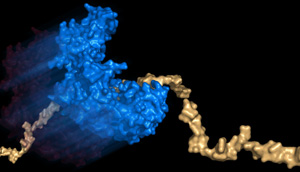
A helicase (blue) moves rapidly on a highly flexible DNA track. Such movement may prevent the accumulation of toxic proteins on the DNA. Graphic courtesy Taekjip HaResearchers studying how proteins called helicases travel along strands of DNA have found that when the proteins hit an obstacle they snap back to where they began, repeating the process over and over, possibly playing a preventative role in keeping the genome intact.

| Molecular & Cell Biology | October 27, 2005 07:32 PM |
| Full story | 0 Comments | 6118 views |

| Stem Cell Research | October 27, 2005 07:32 PM |
Left ventricular function and exercise capacity increased, while the area of heart muscle damage shrank, in 18 patients given infusions of their own bone marrow stem cells up to eight years after a heart attack, according to a new study in the Nov. 1, 2005, issue of the Journal of the American College of Cardiology.
| Full story | 0 Comments | 13475 views |

| Biotechnology | October 27, 2005 07:32 PM |
In follow-on work to last year's groundbreaking toxicological study on water-soluble buckyballs, researchers at Rice University's Center for Biological and Environmental Nanotechnology (CBEN) find that water-soluble carbon nanotubes are significantly less toxic to begin with. Moreover, the research finds that nanotubes, like buckyballs, can be rendered nontoxic with minor chemical modifications.
| Full story | 0 Comments | 6557 views |
| Molecular & Cell Biology | October 27, 2005 07:32 PM |
Researchers at Stanford University have created a larger-than-normal DNA molecule that is copied almost as efficiently as natural DNA. The findings, reported in the Oct. 25 online edition of the Proceedings of the National Academy of Sciences (PNAS), may reveal new insights into how genetic mutations-tiny mistakes that occur during DNA replication-arise. The discovery was made in the laboratory of Eric Kool, a professor of chemistry at Stanford and co-author of the PNAS study.
| Full story | 0 Comments | 7228 views |

| Biology | October 27, 2005 07:31 PM |
Scientists have identified the gene responsible for controlling a first key step in the creation of new life, according to new research published in the journal Nature tomorrow (Thursday 27 October 2005).
| Full story | 0 Comments | 5998 views |

| Bioinformatics | October 27, 2005 07:31 PM |
The International HapMap Project was initiated with the primary goal of facilitating medical studies and understanding the genomic basis for human diseases. To coordinate with the journal Nature's publication describing the HapMap, the journal Genome Research is announcing a special issue entitled "Human Genome Variation," which is entirely devoted to studies using these data to provide insight into human biology and disease.
| Full story | 0 Comments | 5853 views |
| Biology | October 27, 2005 07:31 PM |
Scientists from the Wildlife Conservation Society (WCS) and their Russian colleagues from the Russian Far East recently fitted three wild 40-day-old Siberian tiger cubs with tiny radio-collars, marking the youngest wild tigers to be tracked by scientists.
| Full story | 0 Comments | 8714 views |
| Biology | October 27, 2005 07:31 PM |
Conference addresses western medicine & society's embrace of meditation, press meeting with Dalai Lama, Hopkins Medical Dean Edward Miller, and Georgetown University Professor Aviad Haramati at 8am on Nov. 8
| Full story | 0 Comments | 7386 views |

- In some genetic cases of microcephaly, stem cells fail to launch
- Yale team discovers how Zika virus causes fetal brain damage
- Scientists uncover the way a common cell enzyme alerts the body to invading bacteria
- Arctic gives clues on worst mass extinction of life
- Calcium channel blockers caught in the act at atomic level
Search Bio News Net
Free Biology Newsletter
- Flexibility That A.C.A. Lent to Work Force Is Threatened by...International Herald Tribune
- Bacteria Behind Legionnaires’ Disease Found at New York Police StationInternational Herald Tribune
- Prescription Price Crisis? 28 Million Americans See Spike in Drug...MSNBC.com: Health
- Seizing on Opioid Crisis, a Drug Maker Lobbies Hard for...International Herald Tribune
- Republicans are taking a big political risk on health careAP Health News
- Why We're So Divided Over Saving WolvesNational Geographic News