

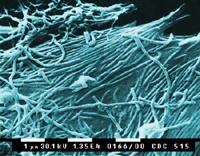
Repeated outbreaks of the Zaire strain of the Ebola virus (Ebola virions pictured above) in central Africa were caused by a recent spread of the virus, rather than by a long-persistent strain at each site. (Photo: Walsh et al.)Over the past ten years, separate outbreaks of the deadly Zaire strain of Ebola virus (ZEBOV) have killed hundreds of humans and tens of thousands of great apes in Gabon and the Republic of Congo--which harbor roughly 80% of the last remaining wild gorilla and chimpanzee populations. In a new study, Peter Walsh, Roman Biek, and Leslie Real combined genetic data with information on the timing and location of past ZEBOV outbreaks to support the hypothesis that a "consistently moving wave of ZEBOV infection" recently spread to outbreak sites in Gabon and Congo.

| Microbiology | October 26, 2005 07:54 PM |
| Full story | 0 Comments | 8255 views |
| Microbiology | October 26, 2005 05:54 PM |
A doctoral student's research brings lessons and insight to a looming pandemic
| Full story | 0 Comments | 5935 views |

| Gene Therapy | October 26, 2005 05:54 PM |
University of Pittsburgh investigators have for the first time used gene therapy to successfully treat heart failure and other degenerative muscle problems in an animal model that is genetically susceptible to a human muscular dystrophy. Reporting in the Oct. 25 edition of the journal Circulation, the authors say that this is the first successful attempt to deliver a therapeutic gene throughout the body.
| Full story | 0 Comments | 12225 views |

| Biotechnology | October 26, 2005 05:54 PM |
Researchers at North Carolina State University are looking deep under water for clues on how to redesign plants for life deep in outer space.
| Full story | 0 Comments | 6819 views |

| Biology | October 26, 2005 05:54 PM |
Nature's finesse revealed in quality surveillance systemWith their latest discovery, researchers have significantly advanced the understanding of how human cells protect themselves from constant and potentially destructive changes in gene expression. According to an article published in this month's Nature Structural & Molecular Biology, the research is important because the protection itself can contribute to disease, and the ability to side-step it may lead to new treatments for hundreds of genetic disorders.
| Full story | 0 Comments | 6018 views |
| Microbiology | October 26, 2005 05:54 PM |
Researchers have identified a gene in mosquitoes that helps the insects to fight off infection by the Plasmodium parasite, which causes malaria in humans. Anopheles mosquitoes transmit the malaria parasite to nearly 550 million people worldwide each year with these cases resulting in more than 2 million deaths annually. The protective gene was identified in a study conducted by a team of investigators from the Johns Hopkins Bloomberg School of Public Health's Malaria Research Institute, the Imperial College of London and the University of Texas Medical Branch. It will be published in the Online Early Edition of the Proceedings of the National Academy of Sciences the week of October 24.
| Full story | 0 Comments | 8291 views |

| Molecular & Cell Biology | October 26, 2005 05:54 PM |
Roots are crucial for the development of strong, healthy crops. But until recently, exactly which genes are involved in the development of roots was still a mystery. Scientists from the Flanders Interuniversity Institute for Biotechnology (VIB) connected to Ghent University have now analyzed a complete plant genome in order to identify the genes that are essential for the formation of capillary roots. For the first time, they are unraveling the genetic basis for the branching of the root system − the key to a plant's further growth and development.
| Full story | 0 Comments | 6562 views |

- In some genetic cases of microcephaly, stem cells fail to launch
- Yale team discovers how Zika virus causes fetal brain damage
- Scientists uncover the way a common cell enzyme alerts the body to invading bacteria
- Arctic gives clues on worst mass extinction of life
- Calcium channel blockers caught in the act at atomic level
Search Bio News Net
Free Biology Newsletter
- Flexibility That A.C.A. Lent to Work Force Is Threatened by...International Herald Tribune
- Bacteria Behind Legionnaires’ Disease Found at New York Police StationInternational Herald Tribune
- Prescription Price Crisis? 28 Million Americans See Spike in Drug...MSNBC.com: Health
- Seizing on Opioid Crisis, a Drug Maker Lobbies Hard for...International Herald Tribune
- Republicans are taking a big political risk on health careAP Health News
- Why We're So Divided Over Saving WolvesNational Geographic News