


Researchers from the University of Pennsylvania School of Medicine have found that inhibitors of an enzyme called cathepsin L prevent the SARS (severe acute respiratory syndrome) virus from entering target cells. SARS is caused by an emergent coronavirus. There is no effective treatment at this time.

| Biology | August 1, 2005 07:23 PM |

A typical monarch butterfly.
photo courtesy of Scott CamazineWhile "navigation" systems in automobiles are a fairly new (and still costly) innovation, monarch butterflies have managed for millennia to navigate their way for a distance of some 3000 miles (4800 kilometers) each fall from Canada to Mexico (and vice-versa in the spring) without losing their way.
| Full story | 0 Comments | 5956 views |

| Biotechnology | August 1, 2005 07:22 PM |
Researchers from Rice University's Center for Biological and Environmental Nanotechnology (CBEN) have developed a "smart" beacon hundreds of times smaller than a human cell that is programmed to light up only when activated by specific proteases. Altered expression of particular proteases is a common hallmark of cancer, atherosclerosis, and many other diseases.
| Full story | 0 Comments | 5056 views |
| Biotechnology | August 1, 2005 07:20 PM |
In a recent study published in the Journal of Biological Chemistry, scientists report on the discovery of a new molecule that is essential for degradation of the biopolymer chitin. This new molecule could eventually aid in the engineering of fungi-resistant plants and could also lead to the discovery of similar molecules that can be used in cellulose-based biofuel production.
| Full story | 0 Comments | 5125 views |
| Biology | August 1, 2005 07:18 PM |
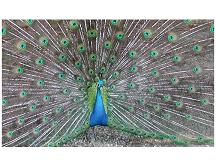
Since Darwin, the peacock exhibiting an elongated tail composed of ocelli has been considered a prime example of the strength of sexual selection. Professor Marion Petrie's classical studies have shown that females prefer males with a high number of ocelli. However, a remaining question concerning the role played by ocelli is how peahens value their number. New research published today in Ethology describes that females may actually assess ocelli density.
| Full story | 0 Comments | 6481 views |
| Biology | August 1, 2005 07:17 PM |
Willow trees, riparian willow warblers and beaver dams once were bountiful in an area near the town of Banff, Alberta, Canada. But once wolves left this area, elk grew more plentiful, browsing heavily on young willows. Today, there is little trace of beavers, and sparrows have replaced the warblers in what is now a grassland meadow. These profound changes were driven by the absence of the wolf, a top predator. That's the compelling finding of the paper, "Human Activity mediates a Trophic Cascade caused by Wolves" that appears in the August issue of Ecology by Mark Hebblewhite (University of Alberta) and colleagues.
| Full story | 0 Comments | 7101 views |

| Molecular & Cell Biology | August 1, 2005 07:16 PM |
Researchers at UT Southwestern Medical Center have discovered a basic mechanism by which smooth muscle cells that line the blood vessels can grow – sometimes abnormally – suggesting methods of treatment for various coronary diseases. Abnormal growth of cells inside blood vessels is involved in hypertension, coronary artery disease, tumors called leiosarcomas and other conditions.
| Full story | 0 Comments | 4516 views |

| Health & Medicine | August 1, 2005 07:14 PM |
What caused leprosy – a widely dreaded disease in medieval Europe – to fade from the scene? By the 16th century, the scourge had practically disappeared there.
The reason seems to be, say researchers at the Hebrew University of Jerusalem and in London, that tuberculosis, a far more deadly disease, overtook leprosy, killing millions throughout Europe.
| Full story | 0 Comments | 5959 views |
| Biology | August 1, 2005 07:13 PM |
Researchers have discovered amphibian species at an accelerating rate in recent decades, with over 1,000 new ones recognized between 1992 and 2003. At the same time, amphibians are, for reasons not entirely clear, declining more rapidly than either mammals or birds, underscoring the importance of an accurate evaluation.
| Full story | 0 Comments | 5724 views |
| Molecular & Cell Biology | August 1, 2005 07:11 PM |
Scientists have identified some of the very earliest genetic changes involved in the development of lung cancer and have incorporated them into a new strain of mouse that develops the disease in much the same way that humans do.
| Full story | 0 Comments | 6459 views |

- In some genetic cases of microcephaly, stem cells fail to launch
- Yale team discovers how Zika virus causes fetal brain damage
- Scientists uncover the way a common cell enzyme alerts the body to invading bacteria
- Arctic gives clues on worst mass extinction of life
- Calcium channel blockers caught in the act at atomic level
Search Bio News Net
Free Biology Newsletter
- Flexibility That A.C.A. Lent to Work Force Is Threatened by...International Herald Tribune
- Bacteria Behind Legionnaires’ Disease Found at New York Police StationInternational Herald Tribune
- Prescription Price Crisis? 28 Million Americans See Spike in Drug...MSNBC.com: Health
- Seizing on Opioid Crisis, a Drug Maker Lobbies Hard for...International Herald Tribune
- Republicans are taking a big political risk on health careAP Health News
- Why We're So Divided Over Saving WolvesNational Geographic News