

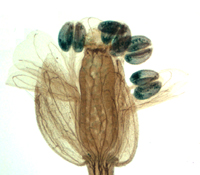
Successful Trap of a Pollen-Specific GeneIdentifying genes based on patterns of gene expression in specific organs or at specific stages of development is a useful approach to improving our understanding of complex biological processes. Scientists Vivian Irish at Yale University in Connecticut, Rob Martienssen at Cold Spring Harbor Laboratory in New York, and their colleagues used a strategy known as "gene trapping" to identify numerous genes involved in the regulation of flower development in the model plant Arabidopsis thaliana.

| Biotechnology | July 31, 2005 05:36 PM |
| Full story | 0 Comments | 13113 views |

| Biology | July 31, 2005 05:34 PM |

Credits: ESAA colourful summer marine phytoplankton bloom fills much of the Baltic Sea in this Envisat image.
Phytoplankton are microscopic marine plants that drift on or near the surface of the sea, by far the most abundant type of life found in the ocean. Just like plants on land they employ green-pigmented chlorophyll for photosynthesis - the process of turning sunlight into chemical energy. While individually microscopic, phytoplankton chlorophyll collectively tints the surrounding ocean waters, providing a means of detecting these tiny organisms from space with dedicated 'ocean colour' sensors.
| Full story | 2 Comments | 33999 views |

| Health & Medicine | July 31, 2005 05:33 PM |
A University of Cincinnati (UC) study provides new evidence that drinking large amounts of beverages containing fructose adds body fat, and might explain why sweetening with fructose could be even worse than using other sweeteners.
| Full story | 0 Comments | 8459 views |
| Biology | July 31, 2005 05:27 PM |
A historic expedition of Census of Marine Life explorers to the planet's most northern reaches has revealed a surprising density and diversity of Arctic Ocean creatures, some believed new to science.
| Full story | 0 Comments | 6224 views |
| Health & Medicine | July 31, 2005 05:26 PM |
Mayo Clinic researchers have found that the cause of chronic sinus infections lies in the nasal mucus -- the snot -- not in the nasal and sinus tissue targeted by standard treatment. The findings will be published in the August issue of Journal of Allergy and Clinical Immunology and are available online.
| Full story | 0 Comments | 10065 views |
| Health & Medicine | July 31, 2005 05:23 PM |
Fears that chemical byproducts resulting from purifying drinking water with chlorine boost the chances that pregnant women will miscarry were not supported by the results of a major new study. If such threats exist at all, which is uncertain, they likely are modest, it concludes.
| Full story | 0 Comments | 6247 views |

| AIDS & HIV | July 31, 2005 05:18 PM |
Two new studies support the hypothesis that combination antiretroviral drug therapy may reduce the risk of mother-to-child HIV transmission through breastfeeding, findings that could have significant implications in the developing world.
| Full story | 0 Comments | 8329 views |

| Molecular & Cell Biology | July 31, 2005 05:17 PM |
From birth until death, our cells migrate: nerve cells make their vital connections, embryonic cells move to the proper places to form organs, immune cells zero in to destroy pathogenic organisms, and cancer cells metastasize, spreading deadly disease through the body. Scientists studying these migrations didn't know how cells determined where to go. Until now.
| Full story | 0 Comments | 6241 views |
| Biotechnology | July 31, 2005 05:15 PM |
A new technique aimed at directly controlling the expression of genes by turning them on or off at the DNA level could lead to drugs for the treatment or cure of many diseases, say researchers at UT Southwestern Medical Center.
| Full story | 0 Comments | 5582 views |
| Molecular & Cell Biology | July 31, 2005 05:13 PM |
Duke University Medical Center researchers have discovered a new mechanism by which chronically high levels of the neurotransmitter dopamine exert their effects on the brain. Normally associated with triggering feelings of pleasure, excess concentrations of dopamine underlie schizophrenia, attention deficit hyperactivity disorder and other psychiatric conditions. The findings therefore provide new research avenues to understand and potentially manage such dopamine-related human disorders, the researchers said.
| Full story | 0 Comments | 7150 views |
| Molecular & Cell Biology | July 31, 2005 05:09 PM |
Brown University biologists have solved the structure of a critical piece of synapse-associated protein 97 (SAP97) found in abundance in the heart and head, where it is believed to play a role in everything from cardiac contractions to memory creation. Results are published in The Journal of Biological Chemistry.
| Full story | 0 Comments | 5655 views |

- In some genetic cases of microcephaly, stem cells fail to launch
- Yale team discovers how Zika virus causes fetal brain damage
- Scientists uncover the way a common cell enzyme alerts the body to invading bacteria
- Arctic gives clues on worst mass extinction of life
- Calcium channel blockers caught in the act at atomic level
Search Bio News Net
Free Biology Newsletter
- Flexibility That A.C.A. Lent to Work Force Is Threatened by...International Herald Tribune
- Bacteria Behind Legionnaires’ Disease Found at New York Police StationInternational Herald Tribune
- Prescription Price Crisis? 28 Million Americans See Spike in Drug...MSNBC.com: Health
- Seizing on Opioid Crisis, a Drug Maker Lobbies Hard for...International Herald Tribune
- Republicans are taking a big political risk on health careAP Health News
- Why We're So Divided Over Saving WolvesNational Geographic News