

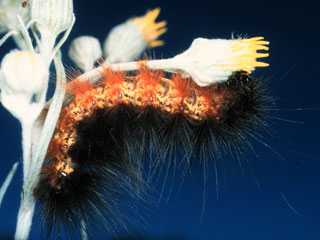
A tiger moth caterpillar feeding on a ragwort plant, which contains toxins that are especially tasty to parasitized caterpillars. Photo: Michael Singer/NATURESome parasites trigger their own destruction by altering their hosts' behavior, researchers at The University of Arizona and Wesleyan University report in Nature. Many parasites have developed mechanisms that suppress their hosts' ability to fight them off or even change their behavior in favor of the parasite. "We found the opposite is true with tiger moth caterpillars and their parasites," said UA Regents' Professor Emerita Elizabeth Bernays.

| Biology | July 29, 2005 07:38 PM |
| Full story | 0 Comments | 10241 views |
| Biology | July 29, 2005 07:35 PM |
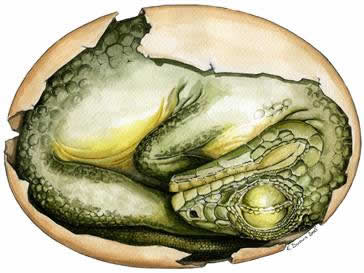
An artist's reconstruction shows a curled-up dinosaur embryo inside an egg. The actual egg is a little more than 2 inches (6 centimeters) in length. Image: Kevin Dupuis, University of Toronto at MississaugaThe embryos of a long-necked, herbivorous dinosaur are the earliest ever recorded for any terrestrial vertebrate and point to how primitive dinosaurs evolved into the largest animals ever to walk on earth, say scientists from the University of Toronto at Mississauga (UTM), the Smithsonian Institution and the University of Witwatersrand, South Africa.
| Full story | 0 Comments | 12282 views |
| Biology | July 29, 2005 07:33 PM |
What do hot sauce aficionados and African elephants have in common? They both feel the burn of chilli peppers, the key ingredient for resolving human-elephant conflicts in Africa while raising money for farmers and conservation.
| Full story | 0 Comments | 6443 views |

| Microbiology | July 29, 2005 07:32 PM |
A collaborative research team from the Uniformed Services University of the Health Sciences (USU), the Australian Animal Health Laboratory (AAHL) and the National Cancer Institute (NCI) have made a major breakthrough in efforts to combat two deadly viruses that could be engineered for use as bioweapons. The team isolated the functional receptor for the Nipah and Hendra viruses--naturally occurring and highly pathogenic paramyxoviruses for which no treatments or vaccines are currently available.
| Full story | 0 Comments | 6253 views |
| Microbiology | July 29, 2005 07:30 PM |
Scientists at Harvard Medical School (HMS) have revealed details of a key step in the entry of anthrax toxin into human cells. The work, which grew out of an ongoing effort to produce a better anthrax therapeutic, shows that the protective antigen component of the bacterial toxin plays an active role in transferring the other two components of the toxin through the cell membrane.
| Full story | 0 Comments | 5875 views |
| Microbiology | July 29, 2005 07:29 PM |
By determining the molecular structure of a protein that enables malaria parasites to invade red blood cells, researchers have uncovered valuable clues for rational antimalarial drug design and vaccine development. The findings are reported in the July 29 issue of the journal Cell.
| Full story | 0 Comments | 6156 views |
| Microbiology | July 29, 2005 07:27 PM |
Two studies by researchers at the University of Chicago show how the bacteria that cause the plague manage to outsmart the immune system and how, by slightly altering one of the microbe's tools, the researchers produced what may be the first safe and effective vaccine.
| Full story | 0 Comments | 6726 views |
| Microbiology | July 29, 2005 07:26 PM |
The human opportunistic pathogen, Pseudomonas aeruginosa, has broken the immune system's code, report researchers from the University of Chicago, enabling the bacteria to recognize when its host is most vulnerable and to launch an attack before the weakened host can muster its defenses.
| Full story | 0 Comments | 8747 views |

| AIDS & HIV | July 29, 2005 07:20 PM |
Random fluctuations in gene expression can influence the fates of cells infected with human immunodeficiency virus (HIV) far more than previously thought, according to new research from Howard Hughes Medical Institute (HHMI) researchers at the University of California, Berkeley. By combining experimental and computational studies of HIV's replication cycle, the researchers found evidence that the virus may become latent in some cells by harnessing the random molecular behavior of the cell.
| Full story | 2 Comments | 8336 views |
| Biology | July 29, 2005 07:09 PM |
A new study released in Science (via Science Express http://www.sciencexpress.org) on July 28th reveals a striking downward trend in the diversity of fish in the open ocean – the largest and least known part of our planet. Teasing apart the effects of climate change and fishing over the past 50 years, the authors show a clear link to overfishing and highlight a surprising global pattern of open ocean hotspots - areas with predictable congregations of tuna, marlin, swordfish, and other ocean predators.
| Full story | 0 Comments | 7211 views |

- In some genetic cases of microcephaly, stem cells fail to launch
- Yale team discovers how Zika virus causes fetal brain damage
- Scientists uncover the way a common cell enzyme alerts the body to invading bacteria
- Arctic gives clues on worst mass extinction of life
- Calcium channel blockers caught in the act at atomic level
Search Bio News Net
Free Biology Newsletter
- Flexibility That A.C.A. Lent to Work Force Is Threatened by...International Herald Tribune
- Bacteria Behind Legionnaires’ Disease Found at New York Police StationInternational Herald Tribune
- Prescription Price Crisis? 28 Million Americans See Spike in Drug...MSNBC.com: Health
- Seizing on Opioid Crisis, a Drug Maker Lobbies Hard for...International Herald Tribune
- Republicans are taking a big political risk on health careAP Health News
- Why We're So Divided Over Saving WolvesNational Geographic News