


It's one of the most common viruses in America, and one that causes the most guilt and shame. It can get inside almost any kind of human cell, reproduce in vast numbers, and linger for years in the body, causing everything from recurrent genital blisters to sores around the mouth. Its complications can kill, and it may increase susceptibility to many nerve and brain disorders.

| General | July 25, 2005 05:47 PM |
As usual, lots of unexpected improvements on the site! I spent a good part of the weekend designing or tweaking icons for the various categories, implementing a better login/logout system (in the right side bar) which follow you site wide (including in the forums), various esthetical changes, category-specific recent discussions, and I'm sure there's more. If you have any suggestions, drop a comment, or write me a mail if you're shy (see bottom of the page)!
Interesting links of the past week :
- British scientist who discovered link with smoking and cancer, dies at 92
- Nanobodies - better & smaller antibodies from camel
- A Disappearing Biome? Reconsidering Land-Cover Change in the Brazilian Savanna
- Arsenic caused the madness of King George III
- GObar: A Gene Ontology based analysis and visualization tool for gene sets
- Medical scans can trigger airport alarms for up to 30 days after
- Seventeen now dead from mystery disease in southwest China
| 0 Comments | 4897 views |

| Biology | July 25, 2005 05:34 PM |
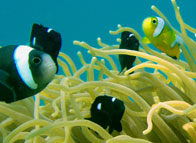
Credit: Jones et al./Current Biology 2005.Tracing the larvae of marine organisms from where they were born to their ultimate destination has been regarded as one of the greatest challenges in ocean science. Managers of marine reserves areas have eagerly sought this information to help determine the optimal size and spacing of marine reserves; well-planned reserves should help ensure that protected populations can sustain themselves as well as provide a source of larvae to maintain exploited populations in areas open to fishing.
| Full story | 0 Comments | 6537 views |
| Biology | July 25, 2005 05:33 PM |
We would immediately notice if the outside world suddenly went dark every few seconds. But we rarely become aware of our blinks, even though they cause a similar reduction in the amount of light entering the eye. So why are we not aware of the frequent mini-blackouts caused by blinks?
| Full story | 0 Comments | 6084 views |

| Molecular & Cell Biology | July 25, 2005 05:32 PM |
Researchers have found new evidence suggesting that the ability to taste bitter compounds has been strongly advantageous in human evolution.
| Full story | 0 Comments | 5062 views |
| Biology | July 25, 2005 05:31 PM |
The brain is bombarded by information about the physical proportions of our bodies. The most familiar sensations, such as a puff of wind or the brush of our own shirt sleeve, serve to constantly remind the brain of the body's outer bounds, creating a sense of what is known as proprioception. In a new study, researchers report this week that the brain's ability to interpret external signals and update its sense of bodily self is more dynamic than had been previously thought and that such updates can happen very quickly, altering within a matter of seconds how body parts and individual touch sensations are perceived.
| Full story | 0 Comments | 5959 views |

| Health & Medicine | July 25, 2005 05:30 PM |
Mathematical models have become invaluable decision-making tools for public health officials. As demonstrated during the United Kingdom's foot-and-mouth epidemic of 2001, models can be useful in two ways: they can reveal the underlying characteristics of an infection and they can allow the comparison of alternative control measures. Often, however, such models make implicit assumptions that may systematically bias their predictions, say researchers at the University of Georgia.
| Full story | 0 Comments | 4487 views |
| Health & Medicine | July 25, 2005 05:29 PM |
Workers in salt factories, who inhale large amounts of salt particles, are at risk of high blood pressure due to the increased salt intake. A study published today in the Open Access journal Environmental Health shows for the first time that breathing in large quantities of salt particles has just the same effect on blood pressure as eating a salty diet. Wearing face masks and plastic eyeglasses is enough to protect workers who are highly exposed to salt from salt-related high blood pressure.
| Full story | 0 Comments | 7691 views |

| Environment | July 25, 2005 05:27 PM |
By firing rapid pulses of polarized light at corn, spinach and other crops, researchers have uncovered a picture of plant health that is invisible to the naked eye. Using a portable light source and detector technology, the researchers can differentiate minute differences in leaf colors - indicators of over- or under-fertilization, crop-nutrient levels and perhaps even disease.
| Full story | 0 Comments | 5105 views |

- In some genetic cases of microcephaly, stem cells fail to launch
- Yale team discovers how Zika virus causes fetal brain damage
- Scientists uncover the way a common cell enzyme alerts the body to invading bacteria
- Arctic gives clues on worst mass extinction of life
- Calcium channel blockers caught in the act at atomic level
Search Bio News Net
Free Biology Newsletter
- Flexibility That A.C.A. Lent to Work Force Is Threatened by...International Herald Tribune
- Bacteria Behind Legionnaires’ Disease Found at New York Police StationInternational Herald Tribune
- Prescription Price Crisis? 28 Million Americans See Spike in Drug...MSNBC.com: Health
- Seizing on Opioid Crisis, a Drug Maker Lobbies Hard for...International Herald Tribune
- Republicans are taking a big political risk on health careAP Health News
- Why We're So Divided Over Saving WolvesNational Geographic News