
Biology News Net
RSS 2.0 Feed
Microbiology

niaid062005_1sm.jpg
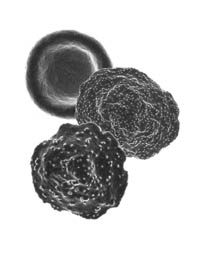
From back to front: normal, uninfected human red blood cell; malaria parasite-infected red blood cell containing hemoglobin A and showing even distribution of small, knob protrusions; malaria parasite-infected red blood cell containing hemoglobin C and displaying abnormally large knob protrusions. (Credit: NIAID)
Scientists have discovered why people with a specific type of hemoglobin--the oxygen-carrying molecule that gives red blood cells their color--are less prone to severe malaria. In a series of experiments, the researchers determined how hemoglobin type C impairs the ability of malaria parasites to cause disease symptoms.

"This research gives us a new insight into malaria, a major global killer that preys especially on young children and claims a life every 30 seconds," notes Anthony S. Fauci, M.D., director of the National Institute of Allergy and Infectious Diseases (NIAID), part of the National Institutes of Health, where the research was conducted.

"If we better understand the natural protective mechanisms against malaria, we might be able to mimic that protective effect through vaccines or drugs," says NIAID researcher Thomas E. Wellems, M.D., Ph.D., whose team's findings appear this week in the journal Nature.

Bioinformatics

The human brain contains from 10 to 100 billion neurons, and each has hundreds of connections with neighboring neurons. Making sense of these intricate connections is essential to understanding brain function, and the task is a monumental one.

Molecular & Cell Biology

Experimenting with Arabidopsis, a fast-growing cousin of the humble mustard plant, scientists at the University of North Carolina at Chapel Hill got a big surprise while investigating how plants respond to attacks from disease organisms such as bacteria and viruses.

AIDS & HIV

The Food and Drug Administration (FDA) today announced the tentative approval of two applications for nevirapine tablets manufactured by Ranbaxy Laboratories Limited, Guragon, India and Aurobindo Pharma Limited, Hyderabad, India. These are the first generic versions of Viramune Tablets manufactured by Boehringer Ingelheim. These products will now be available for consideration for purchase under the President’s Emergency Plan for AIDS Relief (PEPFAR).

Health & Medicine

The 2004-2005 flu season was at least as severe as the 2003-2004 season, but peaked later according to data from Solucient, a leading provider of healthcare information. This later peak may have prevented the most recent flu season from being even worse.

Bioinformatics

By comparing 140 sequenced bacterial genomes, researchers have uncovered a system for regulating genes essential to bacterial replication – and they did it solely by computer keystrokes and mouse clicks.

Mikhail Gelfand, a Howard Hughes Medical Institute international research scholar at the Institute for Information Transmission Problems (IITP) in Moscow, and his postdoctoral fellow, Dmitry Rodionov, used comparative genomics to identify a new transcription factor system in bacteria that represses expression of genes involved in DNA replication. They scanned gene sequences and proteomes of several taxonomic groups of bacteria, identifying not only a highly conserved signal sequence, but also the regulatory transcription factor that bound it, the repressor nature of the signal, and other genes also regulated by this system.