
Biology News Net
RSS 2.0 Feed
Biotechnology

vaults2_r.jpg
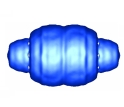
The overall structure of a vault particle. Credit: Reprinted from Journal of Molecular Biology, Mikyas et al, "Cryoelectron Microscopy Imaging of Recombinant and Tissue Derived Vaults..." pp 91-105, with permission from Elsevier.
Naturally occurring nano-capsules, known as "vaults," could provide a whole new class of delivery vehicles for therapeutic drugs and DNA, according to recent research. Indeed, vaults could be used for a wide range of applications in nanotechnology--even though no one can figure out how nature itself uses them.

That's not for lack of trying. In the nearly two decades since vaults were discovered, researchers have found that these hollow, barrel-like structures circulate by the tens of thousands in just about every cell of the human body, as well as in the cells of monkeys, rats, frogs, electric rays and even slime molds. Vaults are presumably doing something worthwhile; otherwise, they never would have survived millions of years of evolution.

Molecular & Cell Biology

Dutch researcher Sebastian Nijman has discovered new genes which are involved in the development of cancer. The results of his research have led to a new treatment for patients with an inherited form of cancer, cylindromatosis.

Patients with the very rare genetic condition cylindromatosis develop a lot of benign tumours on the skin. These tumours mainly occur on the head where they can cause serious malformations.

Biology
BiologyMay 14, 2005 03:35 PM

Dutch researcher Nicole de Voogd has investigated the possibilities for rearing sea sponges in Indonesia. Some of these sponges contain substances of interest to the pharmaceutical industry. As these are increasingly difficult to obtain, there is growing interest in alternative methods of exploitation, such as rearing sponges.

Microbiology

A French genetics study comparing strains of leprosy-causing bacteria has revealed some surprises about how the pathogen evolved and how it was spread across the continents by human migrations. The research, led by scientists at the Pasteur Institute in Paris, appears in the 13 May issue of the journal Science, published by AAAS, the nonprofit science society.

The findings indicate that the world's existing leprosy infections are all caused by a single bacterial clone that has spread yet barely mutated for centuries. They also show that the disease may have begun in East Africa, as opposed to India as previously thought, and then spread to the other continents in part through European colonialism and later the slave trade.

Environment

Despite dozens of interceptions at U.S. ports, a public enemy has infiltrated the nation's borders. Taken captive in Fulton County, N.Y., and identified by a Cornell University expert, the adult female alien is the only one of its kind ever discovered in the eastern United States.

Environment

Coral reefs damaged in the Asian tsunami tragedy should be allowed to recover naturally before countries launch into expensive restoration plans, according to some of the world's leading scientists.

The scientists, led by a researcher from the University of Newcastle upon Tyne, and who set out their views in an advisory brief for the World Bank, point to historical records of major coral reef devastation by cyclones and typhoons, which show that reefs recovered without human intervention.

Biology

Researchers from China and the United States have found evidence of lichen-like symbiosis in 600-million-year-old fossils from South China. The previous earliest evidence of lichen was 400 million years old, discovered in Scotland. The discovery also adds to the scarce fossil record of fungi and raises new questions about lichen evolution.