


I'll be away for the next two days, so updates will resume only on saturday night, I fear; our research team is having its annual meeting where we discuss about past/future projects of everyone (and party quite a lot, too). Don't worry, I'll be back soon enough :)

| Biology | May 12, 2005 12:54 PM |
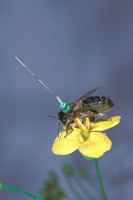
Bee with radar attached.
© BBSRC and Rothamsted ResearchA paper published in Nature on May 12th provides new data that resolves a long-standing scientific controversy. In the 1960s, Nobel Prize winning zoologist, Karl von Frisch, proposed that honeybees use dance (the"waggle dance") as a coded message to guide other bees to new food sources. However, some scientists did not accept von Frisch's theory. Using harmonic radar, scientists, funded in part by the UK's Biotechnology and Biological Sciences Research Council (BBSRC) have now tracked the flight of bees that had attended a "waggle dance" and found that they flew straight to the vicinity of the feeding site, as predicted by von Frisch. The tracks allowed the scientists to determine how accurately bees translate the dance code into successful navigation, and showed that they correct for wind drift even when en route to destinations they have never visited before.
| Full story | 0 Comments | 7782 views |
| Biology | May 12, 2005 12:53 PM |
The brains of one species of mouse actually shrink during the winter, causing the mice to have more difficulty with some types of learning, a new study found.
The results showed that, during the short days of winter, white-footed mice had impaired spatial memory – the mental map that helps them remember important places in their environment.
| Full story | 0 Comments | 5168 views |

| Molecular & Cell Biology | May 12, 2005 12:51 PM |
Scientists at Michigan State University have made a major discovery on the inner workings of genetic coding, mapping out mechanisms of one of life's most elemental functions: RNA synthesis. Their work has crucial implications for how a normal cell forms a tumor and how a virus runs amok.
The work is published in the May 13 edition of the scientific journal Molecular Cell.
| Full story | 0 Comments | 4242 views |
| Molecular & Cell Biology | May 12, 2005 12:50 PM |
The ability of an experimental drug known as GW5638 to change the shape of the estrogen receptor is helping researchers understand why drugs like tamoxifen and raloxifene behave the way they do, simulating the effects of estrogen in some tissues and blocking it in others. The finding indicates that this little-known drug may play an important role in preventing, as well as treating, breast cancer and suggests ways to design new drugs with even more specific effects.
| Full story | 0 Comments | 4678 views |

| Environment | May 12, 2005 12:48 PM |
For years, experts have been calling for an improved database that would enable them to develop more effective global nature conservation strategies. Botanists at the University of Bonn have now taken a major step in this direction with the publication, in the Journal of Biogeography, of a world map of plant biodiversity.
| Full story | 0 Comments | 4625 views |

| Microbiology | May 12, 2005 12:47 PM |
Rahul Kulkarni, assistant professor of physics at Virginia Tech, has been awarded a Ralph E. Powe Junior Faculty Enhancement Award from Oak Ridge Associated Universities to continue his research on quorum sensing in bacteria. He is modeling the sequence of events that initiate activity, such as virulence, by a bacteria colony once it has reached a critical size.
| Full story | 0 Comments | 4024 views |
| Biology | May 12, 2005 12:45 PM |
It seems size does matters after all. But for flying snakes, smaller is better, according to University of Chicago researchers.
In the May 15, 2005, issue of the Journal of Experimental Biology, scientists described the effects of size and behavior of flying snakes, and found that the smaller animals were better gliders.
| Full story | 1 Comment | 8567 views |

- In some genetic cases of microcephaly, stem cells fail to launch
- Yale team discovers how Zika virus causes fetal brain damage
- Scientists uncover the way a common cell enzyme alerts the body to invading bacteria
- Arctic gives clues on worst mass extinction of life
- Calcium channel blockers caught in the act at atomic level
Search Bio News Net
Free Biology Newsletter
- Flexibility That A.C.A. Lent to Work Force Is Threatened by...International Herald Tribune
- Bacteria Behind Legionnaires’ Disease Found at New York Police StationInternational Herald Tribune
- Prescription Price Crisis? 28 Million Americans See Spike in Drug...MSNBC.com: Health
- Seizing on Opioid Crisis, a Drug Maker Lobbies Hard for...International Herald Tribune
- Republicans are taking a big political risk on health careAP Health News
- Why We're So Divided Over Saving WolvesNational Geographic News