

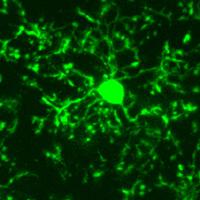
Microglial cell in the brain of transgenic mouse. The extensions of the microglial cells are not static, they change constantly. Image: MPI for Medical ResearchResearchers from the Max Planck Institute for Medical Research in Heidelberg and the Max Planck Institute of Experimental Medicine in Goettingen (Germany) have uncovered the behaviour of microglial cells in the brain. In the current online edition of Science (Science, Epub ahead of print, 14. April 2005) they report on the busy action of these immune defense cells in the normal brain and their rapid response to cerebral hemorrhage in the first few hours following injury. Their imaging approach is transferable to other models of disease, and monitoring microglia behaviour under such circumstances promises to substantially enhance our knowledge about brain pathologies.

| Molecular & Cell Biology | April 15, 2005 04:53 PM |
| Full story | 0 Comments | 6009 views |

| Microbiology | April 15, 2005 04:52 PM |
University of California scientists working at Los Alamos National Laboratory have found that the successful use of bacteria to remediate environmental contamination from nuclear waste and processing activities may depend more upon how resistant the bacteria are to chemicals than to how tolerant they are to radioactivity. The results of a recent Laboratory study may help make bacterial bioremediation a more widespread method for cleaning up sites contaminated with actinides and other radionuclides.
| Full story | 0 Comments | 6962 views |

| Bioinformatics | April 15, 2005 04:50 PM |
More than two decades after it burst onto the scene, HIV/AIDS has claimed more than twenty million lives and continues to devastate societies around the world, particularly in Africa and other developing countries. In the late 1980s and early 1990s, after years of effort AIDS researchers succeeded in developing a class of drugs that proved to be highly effective against AIDS. By blocking the activity of the viral enzyme HIV protease, these protease inhibitors brought greatly extended life-spans to patients who previously faced early deaths. Structural biology and molecular dynamics computer simulations played an important role in these discoveries.
| Full story | 0 Comments | 5482 views |

| Biology | April 15, 2005 04:50 PM |
Ever wondered where your family's ancestors roamed 60,000 years ago?
Now you can find out by participating in the world's most ambitious project tracing the genetic and migratory history of the human race.
| Full story | 0 Comments | 10490 views |

| AIDS & HIV | April 15, 2005 04:47 PM |
Scientists have discovered the mechanism that enables some CD4 T cells -- the main target of HIV -- to thwart the virus. The discovery, reported on April 13 in the online version of Nature, could open the door to an entirely new strategy for preventing the spread of HIV infection in the body's cells, according to the senior author of the study, Gladstone Institute of Virology and Immunology Director Warner C. Greene, MD, PhD.
| Full story | 0 Comments | 6348 views |

- In some genetic cases of microcephaly, stem cells fail to launch
- Yale team discovers how Zika virus causes fetal brain damage
- Scientists uncover the way a common cell enzyme alerts the body to invading bacteria
- Arctic gives clues on worst mass extinction of life
- Calcium channel blockers caught in the act at atomic level
Search Bio News Net
Free Biology Newsletter
- Flexibility That A.C.A. Lent to Work Force Is Threatened by...International Herald Tribune
- Bacteria Behind Legionnaires’ Disease Found at New York Police StationInternational Herald Tribune
- Prescription Price Crisis? 28 Million Americans See Spike in Drug...MSNBC.com: Health
- Seizing on Opioid Crisis, a Drug Maker Lobbies Hard for...International Herald Tribune
- Republicans are taking a big political risk on health careAP Health News
- Why We're So Divided Over Saving WolvesNational Geographic News