

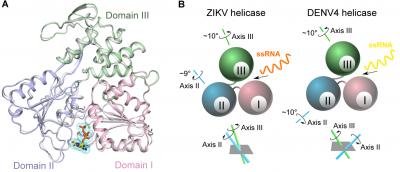
This is the structure of the ZIKV helicase in complex with RNA. Zika virus has now become a household word. It can cause microcephaly, a birth defect where a baby's head is smaller than usual. Additionally, it is associated with Guillain-Barré syndrome, a neurological disorder that could lead to paralysis and even death. However, how this microbe replicates in the infected cells remains a mystery. Now, an international team led by researchers from Tianjin University and Nankai University has unraveled the puzzle of how Zika virus replicates and published their finding in Springer's journal Protein & Cell.

| Microbiology | July 26, 2016 03:43 PM |
| Full story | 0 Comments | 36946 views |

| Molecular & Cell Biology | July 26, 2016 03:43 PM |
Roundworms (Caenorhabditis elegans) with a disabled eri-1 gene can lose their ability to control repetitive DNA. In the absence of eri-1, even two age-matched siblings can look dramatically different. 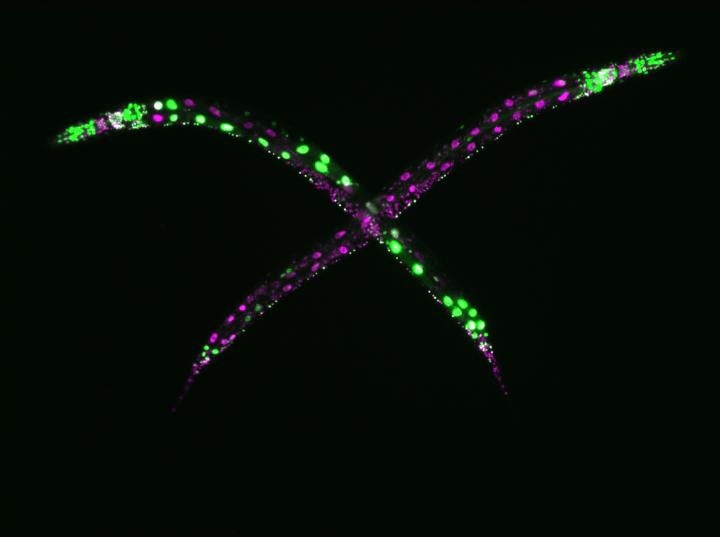
| Full story | 0 Comments | 6429 views |

- In some genetic cases of microcephaly, stem cells fail to launch
- Yale team discovers how Zika virus causes fetal brain damage
- Scientists uncover the way a common cell enzyme alerts the body to invading bacteria
- Arctic gives clues on worst mass extinction of life
- Calcium channel blockers caught in the act at atomic level
Search Bio News Net
Free Biology Newsletter
- Flexibility That A.C.A. Lent to Work Force Is Threatened by...International Herald Tribune
- Bacteria Behind Legionnaires’ Disease Found at New York Police StationInternational Herald Tribune
- Prescription Price Crisis? 28 Million Americans See Spike in Drug...MSNBC.com: Health
- Seizing on Opioid Crisis, a Drug Maker Lobbies Hard for...International Herald Tribune
- Republicans are taking a big political risk on health careAP Health News
- Why We're So Divided Over Saving WolvesNational Geographic News