

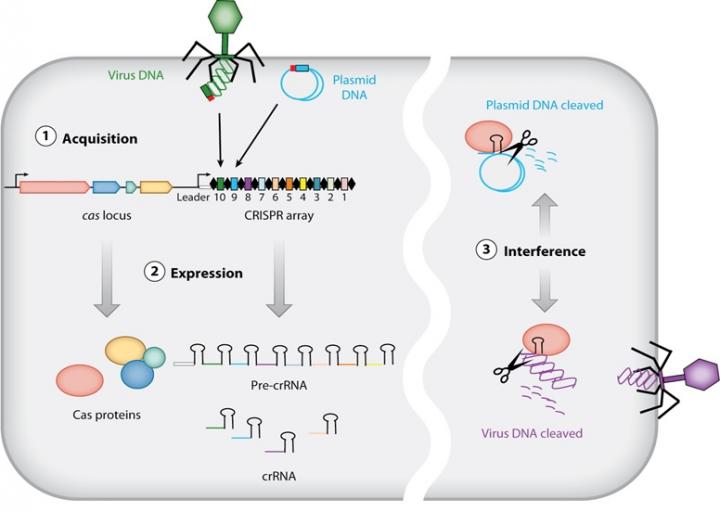
This is an illustration of how the CRISPR/Cas system works, courtesy of Devaki Bhaya, Michelle Davison, and Rodolphe Barrangou. You've probably seen news stories about the highly lauded, much-discussed genome editing system CRISPR/Cas9. But did you know the system was actually derived from bacteria, which use it to fight off foreign invaders such as viruses? It allows many bacteria to snip and store segments of DNA from an invading virus, which they can then use to "remember" and destroy DNA from similar invaders if they are encountered again. Recent work from a team of researchers including Carnegie's Devaki Bhaya demonstrates that some bacteria also use the CRISPR/Cas system to snip and recognize segments of RNA, not just DNA. It was published by Science.

| Molecular & Cell Biology | March 2, 2016 06:15 PM |
| Full story | 0 Comments | 6124 views |

| Biotechnology | March 2, 2016 06:15 PM |
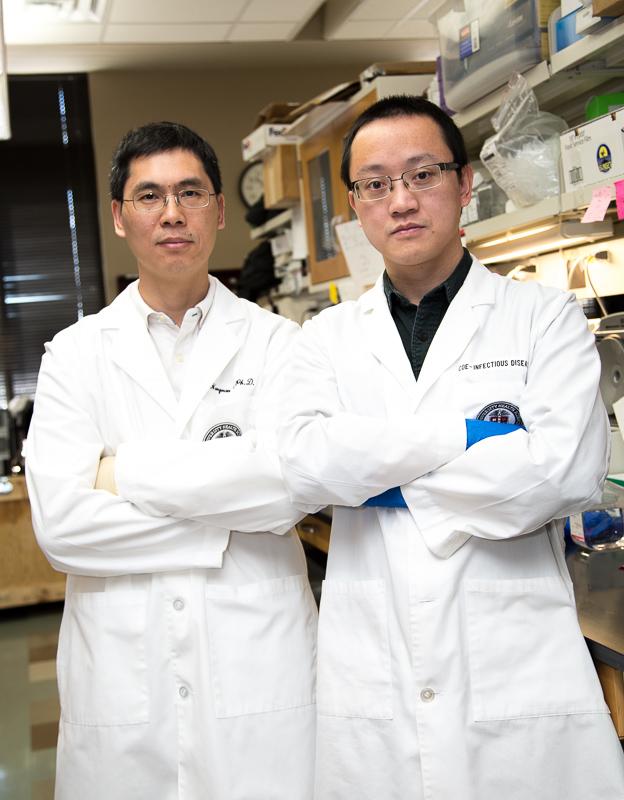
Haoquan Wu, Ph.D., left, and Ying Dang, Ph.D., right, have improved the gene editing technology CRISPR and enhanced its ability to target and knockout genes. Scientists have developed a process that improves the efficiency of CRISPR, an up-and-coming technology used to edit DNA.
| Full story | 0 Comments | 7145 views |
| Molecular & Cell Biology | March 2, 2016 06:15 PM |
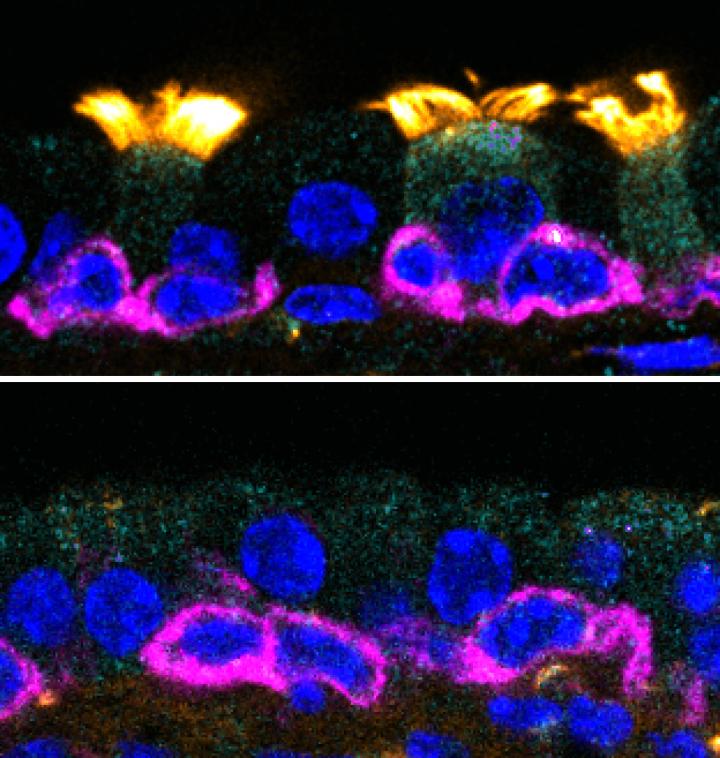
GEMC1 is required for the generation of multiciliated cells. Images of mouse tracheas. The genomic sequencing of hundreds of patients with diverse types of ciliopathies has revealed that "in many cases the gene responsible is not known", says Travis Stracker, head of the Genomic Instability and Cancer Lab at the IRB Barcelona. "So many people do not have a molecular diagnosis," stresses the researcher. "Our work seeks to contribute to bridging this knowledge gap".
| Full story | 0 Comments | 7406 views |

- In some genetic cases of microcephaly, stem cells fail to launch
- Yale team discovers how Zika virus causes fetal brain damage
- Scientists uncover the way a common cell enzyme alerts the body to invading bacteria
- Arctic gives clues on worst mass extinction of life
- Calcium channel blockers caught in the act at atomic level
Search Bio News Net
Free Biology Newsletter
- Flexibility That A.C.A. Lent to Work Force Is Threatened by...International Herald Tribune
- Bacteria Behind Legionnaires’ Disease Found at New York Police StationInternational Herald Tribune
- Prescription Price Crisis? 28 Million Americans See Spike in Drug...MSNBC.com: Health
- Seizing on Opioid Crisis, a Drug Maker Lobbies Hard for...International Herald Tribune
- Republicans are taking a big political risk on health careAP Health News
- Why We're So Divided Over Saving WolvesNational Geographic News