

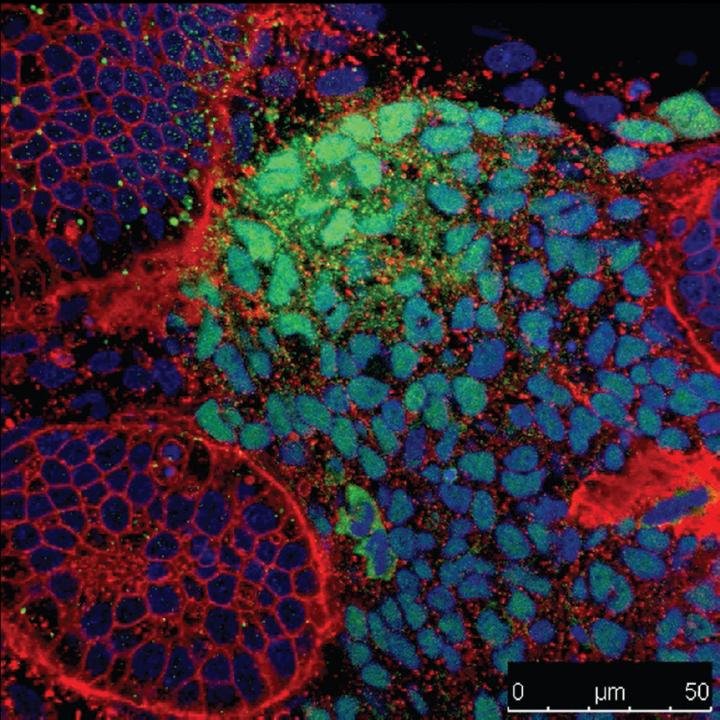
In this micrograph, embryonic rat kidney cell aggregates are colored red. Differentiated human cells incorporated into these aggregates are colored green. Blue marks DNA in all cells. Human pluripotent stem cells (hPSC) can become any type of cell in the adult body, offering great potential in disease modeling, drug discovery and creating replacement cells for conditions ranging from cardiovascular to Alzheimer's disease.

| Stem Cell Research | November 10, 2015 06:01 PM |
| Full story | 0 Comments | 9086 views |

| Biotechnology | November 10, 2015 06:01 PM |

Plant Breeding Institute's Principal Research Fellow, Associate Professor Harbans Bariana, is demonstrating the issue of wheat rust. A gene that can prevent some of the most important wheat diseases has been identified--creating the potential to save more than a billion dollars in lost production in Australia alone each year.
| Full story | 0 Comments | 9422 views |

| Environment | November 10, 2015 06:01 PM |

This is an example of a healthy reef. Almost every person has an appreciation for natural environments. In addition, most people find healthy or pristine locations with high biodiversity more beautiful and aesthetically pleasing than environmentally degraded locations. In a study which computed 'aesthetics' as it relates to coral reefs, a multidisciplinary group of researchers have shown that an objective computational analysis of photographic images can be used to assess the health of a coral reef.
| Full story | 0 Comments | 7882 views |

| Health & Medicine | November 10, 2015 06:01 PM |
Researchers from the University of North Carolina at Chapel Hill have discovered a new bat SARS-like virus that can jump directly from its bat hosts to humans without mutation. However, researchers point out that if the SARS-like virus did jump, it is still unclear whether it could spread from human to human.
| Full story | 0 Comments | 6488 views |
| Health & Medicine | November 10, 2015 06:01 PM |
Scientists at the Institut Pasteur in Cambodia, the Institut Pasteur in Paris and the CNRS provided proof that people infected by dengue virus but showing no clinical symptoms can actually infect mosquitoes that bite them. It appears that these asymptomatic people - who, together with mildly symptomatic patients, represent three-quarters of all dengue infections - could be involved in the transmission chain of the virus. These findings, published in the journal PNAS, on the 9 of November, question established theories concerning the epidemiology of dengue.
| Full story | 0 Comments | 6479 views |

- In some genetic cases of microcephaly, stem cells fail to launch
- Yale team discovers how Zika virus causes fetal brain damage
- Scientists uncover the way a common cell enzyme alerts the body to invading bacteria
- Arctic gives clues on worst mass extinction of life
- Calcium channel blockers caught in the act at atomic level
Search Bio News Net
Free Biology Newsletter
- Flexibility That A.C.A. Lent to Work Force Is Threatened by...International Herald Tribune
- Bacteria Behind Legionnaires’ Disease Found at New York Police StationInternational Herald Tribune
- Prescription Price Crisis? 28 Million Americans See Spike in Drug...MSNBC.com: Health
- Seizing on Opioid Crisis, a Drug Maker Lobbies Hard for...International Herald Tribune
- Republicans are taking a big political risk on health careAP Health News
- Why We're So Divided Over Saving WolvesNational Geographic News