

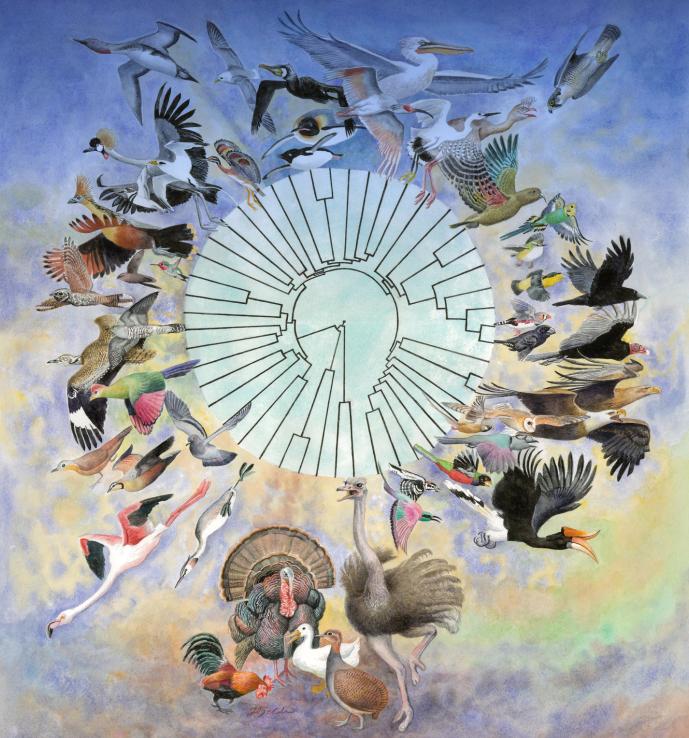
The new avian family tree based on whole genomes of 48 bird species representing all 30 neoavian orders and two galloanserae orders and two palaeognathae orders. The Avian Phylogenomics Consortium formally announces the launch of the Bird 10,000 genomes (B10K) project, an initiative to generate representative draft genome sequences from all extant bird species within the next five years. This will be the first attempt to sequence the genomes of all living species of a vertebrate class. The establishment of this project is built on the success of the previous ordinal level project, which provided the first proof of concept for carrying out large-scale sequencing of multiple representative species across a vertebrate class and a window into the types of discoveries that can be made with such genomes (1). The announcement of the B10K project is published online today in Nature.

| Bioinformatics | June 5, 2015 03:52 AM |
| Full story | 0 Comments | 6720 views |

| Molecular & Cell Biology | June 5, 2015 03:52 AM |
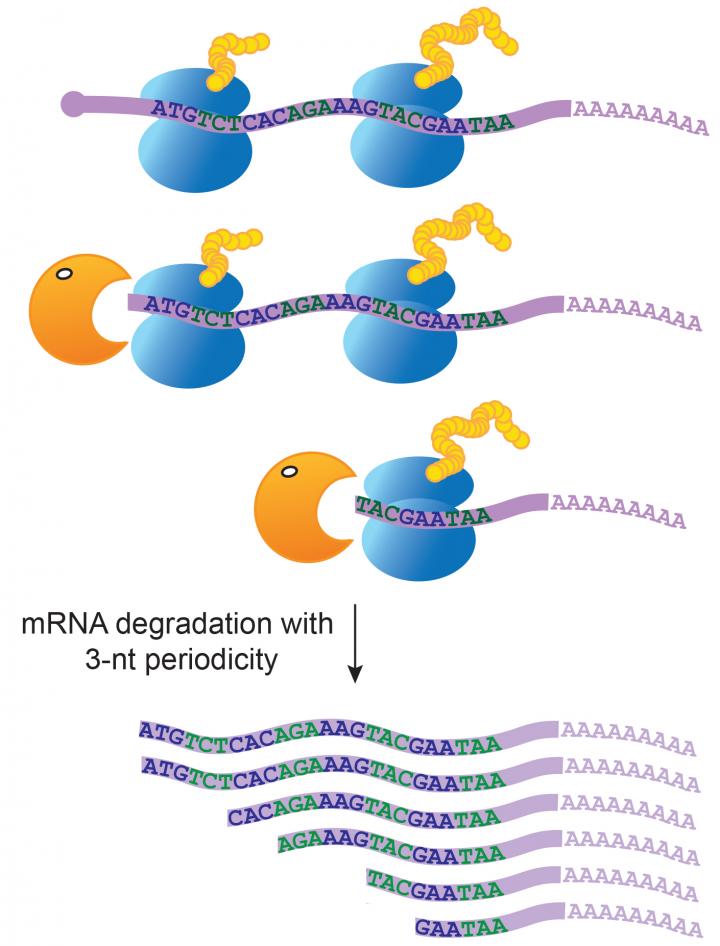
The enzyme that degrades messenger RNA follows the ribosomes and stops every 3 nucleotides. Once messenger RNA (mRNA) has done its job - conveying the information to produce the proteins necessary for a cell to function - it is no longer required and is degraded. Scientists have long thought that the decay started after translation was complete and that decaying RNA molecules provided little biological information.
| Full story | 0 Comments | 7174 views |

| Microbiology | June 5, 2015 03:52 AM |
From a single drop of blood, researchers can now simultaneously test for more than 1,000 different strains of viruses that currently or have previously infected a person. Using a new method known as VirScan, researchers from Brigham and Women's Hospital (BWH) and Harvard Medical School tested for evidence of past viral infections, detecting on average 10 viral species per person. The new work sheds light on the interplay between a person's immunity and the human virome -- the vast array of viruses that can infect humans - with implications both for the clinic and for the field of immunology. The team reports its findings in Science on June 5.
| Full story | 0 Comments | 6278 views |
| Molecular & Cell Biology | June 5, 2015 03:52 AM |
The process that allows our brains to learn and generate new memories also leads to degeneration as we age, according to a new study by researchers at MIT.
| Full story | 0 Comments | 6655 views |
| Microbiology | June 5, 2015 03:52 AM |
At its annual assembly in Geneva last week, the World Health Organization approved a radical and far-reaching plan to slow the rapid, extensive spread of antibiotic resistance around the world. The plan hopes to curb the rise caused by an unchecked use of antibiotics and lack of new antibiotics on the market.
| Full story | 0 Comments | 6690 views |

- In some genetic cases of microcephaly, stem cells fail to launch
- Yale team discovers how Zika virus causes fetal brain damage
- Scientists uncover the way a common cell enzyme alerts the body to invading bacteria
- Arctic gives clues on worst mass extinction of life
- Calcium channel blockers caught in the act at atomic level
Search Bio News Net
Free Biology Newsletter
- Flexibility That A.C.A. Lent to Work Force Is Threatened by...International Herald Tribune
- Bacteria Behind Legionnaires’ Disease Found at New York Police StationInternational Herald Tribune
- Prescription Price Crisis? 28 Million Americans See Spike in Drug...MSNBC.com: Health
- Seizing on Opioid Crisis, a Drug Maker Lobbies Hard for...International Herald Tribune
- Republicans are taking a big political risk on health careAP Health News
- Why We're So Divided Over Saving WolvesNational Geographic News