

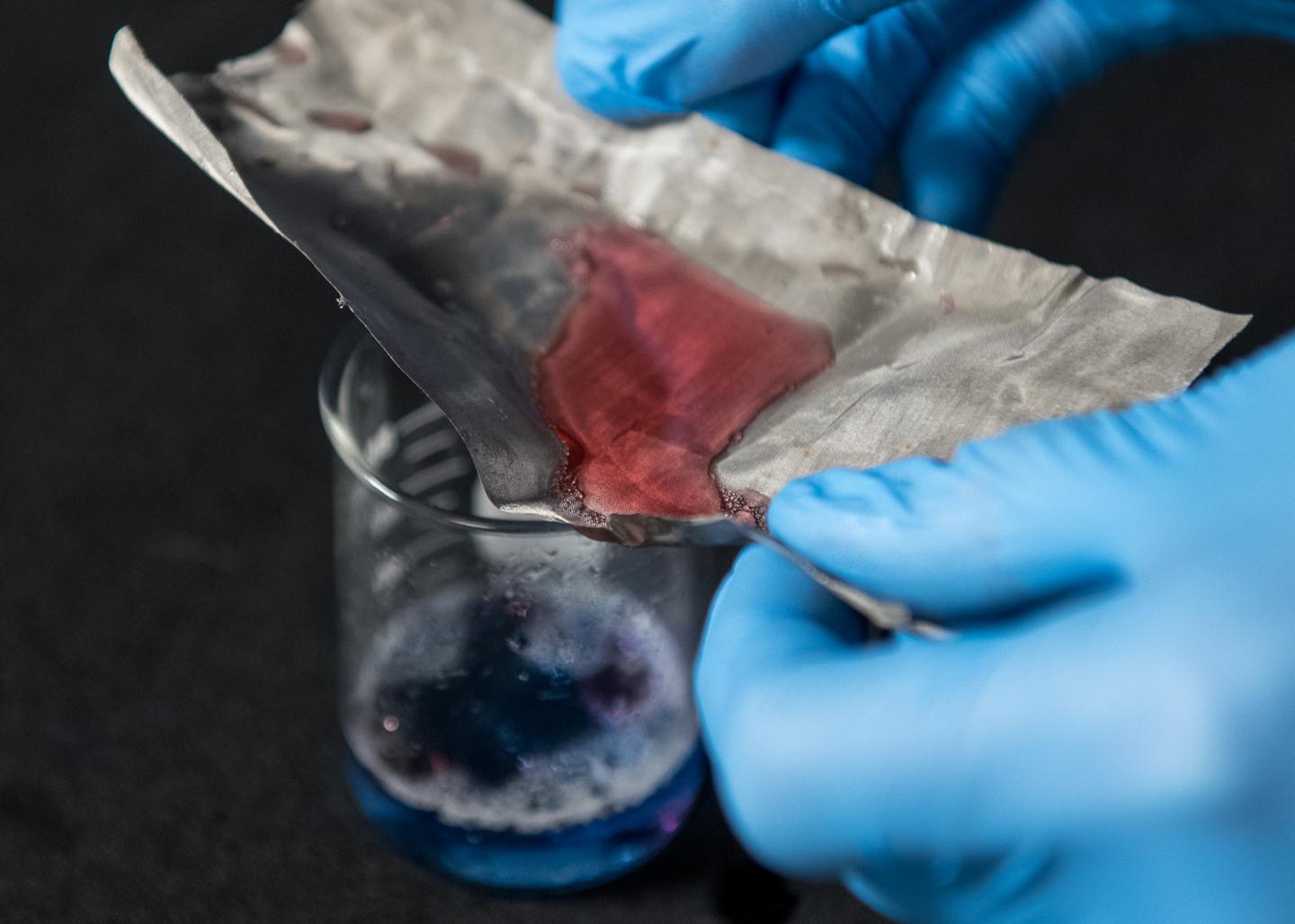
This mesh, which is covered in a coating invented at The Ohio State University, captures oil (red) while water (blue) passes through. The unassuming piece of stainless steel mesh in a lab at The Ohio State University doesn't look like a very big deal, but it could make a big difference for future environmental cleanups.

| Environment | April 15, 2015 06:12 PM |
| Full story | 0 Comments | 7063 views |

| Microbiology | April 15, 2015 06:12 PM |
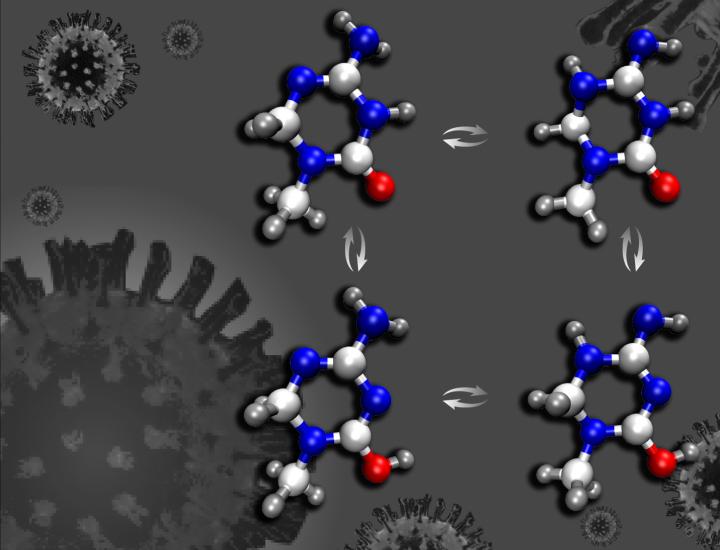
This image depicts the shape-shifting capabilities of the anti-HIV drug KP1212. A newly developed spectroscopy method is helping to clarify the poorly understood molecular process by which an anti-HIV drug induces lethal mutations in the virus's genetic material. The findings from the University of Chicago and the Massachusetts Institute of Technology could bolster efforts to develop the next generation of anti-viral treatments.
| Full story | 0 Comments | 6128 views |

| Biotechnology | April 15, 2015 06:12 PM |
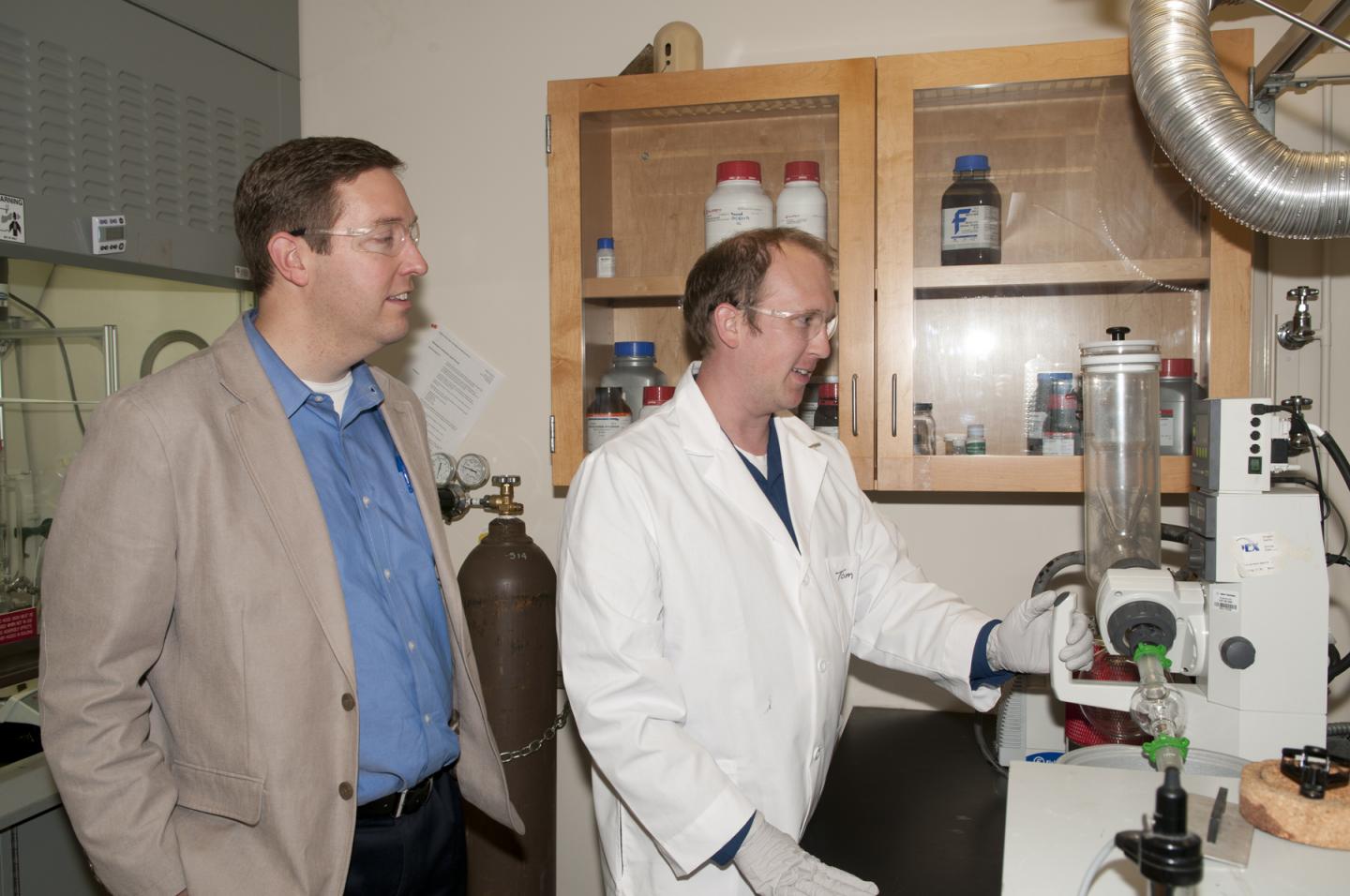
Michael Kessler, left, a professor in the Washington State University School of Mechanical and Materials Engineering, has developed polyurethane based on plant oils. Washington State University researchers have developed a new way to use plant oils like olive and linseed oil to create polyurethane, a plastic material used in everything from foam insulation panels to tires, hoses and sealants.
| Full story | 0 Comments | 6348 views |

| Molecular & Cell Biology | April 15, 2015 06:12 PM |
New work by Ludwig-Maximilians-Universitaet (LMU) in Munich researchers demonstrates that macrophages can effectively substitute for so-called dendritic cells as primers of T-cell-dependent immune responses. Indeed, they stimulate a broader-based response.
| Full story | 0 Comments | 4838 views |
| Molecular & Cell Biology | April 15, 2015 06:12 PM |
Researchers from North Carolina State University and the University of Colorado, Boulder, have developed a statistical model that allows them to tell where a dust sample came from within the continental United States based on the DNA of fungi found in the sample.
| Full story | 0 Comments | 4222 views |

| Biology | April 15, 2015 06:12 PM |
The neural network necessary for normal face recognition has been not fully understood yet until now. Here, the research group of Dr. Daisuke Matsuyoshi (present affiliation: The University of Tokyo) led by Prof. Ryusuke Kakigi and Prof. Norihiro Sadato of the National Institute for Physiological Sciences (NIPS), National Institutes of Natural Sciences (NINS), by using the functional magnetic resonance imaging (fMRI), revealed that suppression of the brain area responsible for object recognition by that for face recognition is necessarily for "normal face" recognition. The researchers simulated mathematically networks between the brain areas and showed that not only brain areas that execute face recognition but also brain areas that had been considered non-essential to face recognition are important for "normal face" recognition. This result was published in The Journal of Neuroscience, the weekly official journal of the Society for Neuroscience, Washington, DC.
| Full story | 0 Comments | 4606 views |

- In some genetic cases of microcephaly, stem cells fail to launch
- Yale team discovers how Zika virus causes fetal brain damage
- Scientists uncover the way a common cell enzyme alerts the body to invading bacteria
- Arctic gives clues on worst mass extinction of life
- Calcium channel blockers caught in the act at atomic level
Search Bio News Net
Free Biology Newsletter
- Flexibility That A.C.A. Lent to Work Force Is Threatened by...International Herald Tribune
- Bacteria Behind Legionnaires’ Disease Found at New York Police StationInternational Herald Tribune
- Prescription Price Crisis? 28 Million Americans See Spike in Drug...MSNBC.com: Health
- Seizing on Opioid Crisis, a Drug Maker Lobbies Hard for...International Herald Tribune
- Republicans are taking a big political risk on health careAP Health News
- Why We're So Divided Over Saving WolvesNational Geographic News