


Two teams of researchers, including a scientist from Case Western Reserve University, have announced the discovery of a new species of fossil horse from 4.4 million-year-old fossil-rich deposits in Ethiopia.

| Biotechnology | December 12, 2013 07:32 PM |
Since the completion of the Human Genome Project, which identified nearly 20,000 protein-coding genes, scientists have been trying to decipher the roles of those genes. A new approach developed at MIT, the Broad Institute, and the Whitehead Institute should speed up the process by allowing researchers to study the entire genome at once.
| Full story | 0 Comments | 7769 views |

| Microbiology | December 12, 2013 07:32 PM |
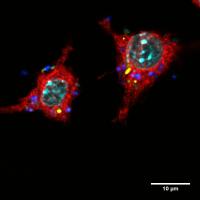
Macrophage (in red) infected with fluorescent labelled E. coli (in yellow or blue).
Bacteria can evolve rapidly to adapt to environmental change. Bacteria can evolve rapidly to adapt to environmental change. When the "environment" is the immune response of an infected host, this evolution can turn harmless bacteria into life-threatening pathogens. A study published on December 12 in PLOS Pathogens provides insight into how this happens.
| Full story | 0 Comments | 6912 views |

- In some genetic cases of microcephaly, stem cells fail to launch
- Yale team discovers how Zika virus causes fetal brain damage
- Scientists uncover the way a common cell enzyme alerts the body to invading bacteria
- Arctic gives clues on worst mass extinction of life
- Calcium channel blockers caught in the act at atomic level
Search Bio News Net
Free Biology Newsletter
- Flexibility That A.C.A. Lent to Work Force Is Threatened by...International Herald Tribune
- Bacteria Behind Legionnaires’ Disease Found at New York Police StationInternational Herald Tribune
- Prescription Price Crisis? 28 Million Americans See Spike in Drug...MSNBC.com: Health
- Seizing on Opioid Crisis, a Drug Maker Lobbies Hard for...International Herald Tribune
- Republicans are taking a big political risk on health careAP Health News
- Why We're So Divided Over Saving WolvesNational Geographic News