


A simpler and faster way of producing designer bacteria used in biotechnology processes has been developed by University of Adelaide researchers.

| Molecular & Cell Biology | May 28, 2013 04:35 PM |
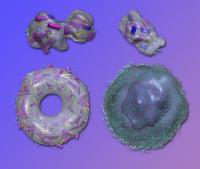
Fluctuation x-ray scattering is the basis of a new technique for rapidly modeling the shapes of large biological models. To learn how biological molecules like proteins function, scientists must first understand their structures. Almost as important is understanding how the structures change, as molecules in the native state do their jobs.
| Full story | 0 Comments | 6344 views |

| Biology | May 28, 2013 04:35 PM |
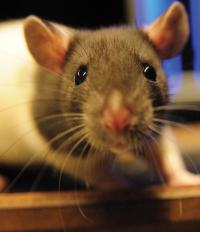
Rats process visual information from their eyes similar to other mammals. Nevertheless, their eyes move in a very different way. Unlike humans, their eyes can move in opposite directions. Scientists from the Max Planck Institute for Biological Cybernetics in Tübingen, using miniaturised high-speed cameras and high-speed behavioural tracking, discovered that rats move their eyes in opposite directions in both the horizontal and the vertical plane when running around. Each eye moves in a different direction, depending on the change in the animal's head position. An analysis of both eyes' field of view found that the eye movements exclude the possibility that rats fuse the visual information into a single image like humans do. Instead, the eyes move in such a way that enables the space above them to be permanently in view – presumably an adaptation to help them deal with the major threat from predatory birds that rodents face in their natural environment.
| Full story | 0 Comments | 11836 views |
| Biology | May 28, 2013 04:35 PM |
The growth of plants toward light is particularly important at the beginning of their lifecycle. Many seeds germinate in the soil and get their nutrition in the dark from their limited reserves of starch and lipids. Reaching for the surface, the seedlings rapidly grow upwards against the gravitational pull, which provides an initial clue for orientation. With the help of highly sensitive light-sensing proteins, they find the shortest route to the sunlight – and are even able to bend in the direction of the light source.
| Full story | 0 Comments | 12051 views |

| Bioinformatics | May 28, 2013 04:35 PM |
Camels are divided into two species, the one-humped dromedary and the two-humped Bactrian camel. Whether equipped with one or two humps, camels are precious in desert regions throughout the world. Their ability to carry heavy loads over long distances makes them ideally suited for transportation. In addition, camels are able to survive for weeks in hostile environments without food and water. Despite the extremely arid conditions, camels still provide enough milk for human consumption and also have an important role as a source of meat. Camels are specialists when it comes to adapting to the environment and have been characterized as sustainable food producers.
| Full story | 0 Comments | 10950 views |

- In some genetic cases of microcephaly, stem cells fail to launch
- Yale team discovers how Zika virus causes fetal brain damage
- Scientists uncover the way a common cell enzyme alerts the body to invading bacteria
- Arctic gives clues on worst mass extinction of life
- Calcium channel blockers caught in the act at atomic level
Search Bio News Net
Free Biology Newsletter
- Flexibility That A.C.A. Lent to Work Force Is Threatened by...International Herald Tribune
- Bacteria Behind Legionnaires’ Disease Found at New York Police StationInternational Herald Tribune
- Prescription Price Crisis? 28 Million Americans See Spike in Drug...MSNBC.com: Health
- Seizing on Opioid Crisis, a Drug Maker Lobbies Hard for...International Herald Tribune
- Republicans are taking a big political risk on health careAP Health News
- Why We're So Divided Over Saving WolvesNational Geographic News