


Northwestern Medicine scientists have identified a component of the herpesvirus that "hijacks" machinery inside human cells, allowing the virus to rapidly and successfully invade the nervous system upon initial exposure.

| Bioinformatics | March 28, 2013 07:11 PM |
The genome of the western painted turtle (Chrysemys picta bellii) one of the most widespread, abundant and well-studied turtles in the world, is published this week in Genome Biology. The data show that, like turtles themselves, the rate of genome evolution is extremely slow; turtle genomes evolve at a rate that is about a third that of the human genome and a fifth that of the python, the fastest lineage analyzed.
| Full story | 0 Comments | 7631 views |

| AIDS & HIV | March 28, 2013 07:11 PM |
Human cells have an intrinsic capacity to destroy HIV. However, the virus has evolved to contain a gene that blocks this ability. When this gene is removed from the virus, the innate human immune system destroys HIV by mutating it to the point where it can no longer survive.
| Full story | 0 Comments | 9463 views |

| Health & Medicine | March 28, 2013 07:11 PM |
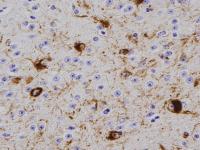
This shows lewy bodies. Brown spots are immunostaining using an antibody specifically recognizing an abnormal form of alpha-synuclein. Clumps of α-synuclein protein in nerve cells are hallmarks of many degenerative brain diseases, most notably Parkinson's disease.
| Full story | 0 Comments | 8738 views |

- In some genetic cases of microcephaly, stem cells fail to launch
- Yale team discovers how Zika virus causes fetal brain damage
- Scientists uncover the way a common cell enzyme alerts the body to invading bacteria
- Arctic gives clues on worst mass extinction of life
- Calcium channel blockers caught in the act at atomic level
Search Bio News Net
Free Biology Newsletter
- Flexibility That A.C.A. Lent to Work Force Is Threatened by...International Herald Tribune
- Bacteria Behind Legionnaires’ Disease Found at New York Police StationInternational Herald Tribune
- Prescription Price Crisis? 28 Million Americans See Spike in Drug...MSNBC.com: Health
- Seizing on Opioid Crisis, a Drug Maker Lobbies Hard for...International Herald Tribune
- Republicans are taking a big political risk on health careAP Health News
- Why We're So Divided Over Saving WolvesNational Geographic News