

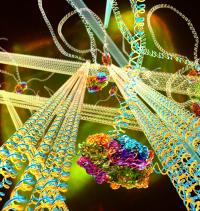
The DNA gel is composed of stiff DNA nanotubes connected to each other via long, flexible DNA linkers. Artificial muscles and self-propelled goo may be the stuff of Hollywood fiction, but for UC Santa Barbara scientists Omar Saleh and Deborah Fygenson, the reality of it is not that far away. By blending their areas of expertise, the pair have created a dynamic gel made of DNA that mechanically responds to stimuli in much the same way that cells do. The results of their research were published online in the Proceedings of the National Academy of Sciences.

| Biotechnology | October 23, 2012 06:05 PM |
| Full story | 0 Comments | 12454 views |

| Health & Medicine | October 23, 2012 06:05 PM |
Lead scientist Professor Simon Cutting, from the School of Biological Sciences at Royal Holloway, has developed the jabs through the use of probiotic spores. He carried out fundamental studies into the biology of the bacterium Bacillus subtilis which attracted the attention of microbiologists due to its ability to form spores that can last millions of years before germinating under the appropriate environmental conditions.
| Full story | 0 Comments | 13069 views |

| Environment | October 23, 2012 06:04 PM |

Paragorga arborea, also known as bubblegum coral, is a conspicuous and locally abundant coral species that can grow massive colonies, which can reach up to 8 meters in height The ability of deep-sea corals to harbor a broad array of marine life, including commercially important fish species, make these habitat-forming organisms of immediate interest to conservationists, managers, and scientists. Understanding and protecting corals requires knowledge of the historical processes that have shaped their biodiversity and biogeography.
| Full story | 0 Comments | 8079 views |

| Biology | October 23, 2012 06:04 PM |
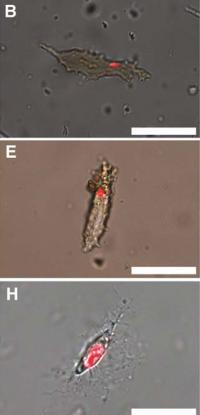
T.rex (B), B. canadensis (E) and ostrich osteocytes (H) showing positive response to propidium iodide A team of researchers from North Carolina State University and the Palo Alto Research Center (PARC) has found more evidence for the preservation of ancient dinosaur proteins, including reactivity to antibodies that target specific proteins normally found in bone cells of vertebrates. These results further rule out sample contamination, and help solidify the case for preservation of cells – and possibly DNA – in ancient remains.
| Full story | 0 Comments | 9123 views |

- In some genetic cases of microcephaly, stem cells fail to launch
- Yale team discovers how Zika virus causes fetal brain damage
- Scientists uncover the way a common cell enzyme alerts the body to invading bacteria
- Arctic gives clues on worst mass extinction of life
- Calcium channel blockers caught in the act at atomic level
Search Bio News Net
Free Biology Newsletter
- Flexibility That A.C.A. Lent to Work Force Is Threatened by...International Herald Tribune
- Bacteria Behind Legionnaires’ Disease Found at New York Police StationInternational Herald Tribune
- Prescription Price Crisis? 28 Million Americans See Spike in Drug...MSNBC.com: Health
- Seizing on Opioid Crisis, a Drug Maker Lobbies Hard for...International Herald Tribune
- Republicans are taking a big political risk on health careAP Health News
- Why We're So Divided Over Saving WolvesNational Geographic News