

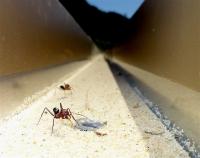
Cataglyphis noda ants approach their nest entrance -- a small hole in the ground of an experimental tube.
Desert ants have adapted to a life in a barren environment which only provides very few landmarks for orientation. Apart from visual cues and odors the ants use the polarized sunlight as a compass and count their steps in order to return safely to their home after searching for food. In experiments with ants of the genus Cataglyphis in their natural habitats in Tunisia and Turkey, behavioral scientists of the Max Planck Institute for Chemical Ecology in Jena, Germany, have now discovered that ants can also use magnetic and vibrational landmarks in order to find their way back to their nest − a small hole in the desert ground. In addition, carbon dioxide produced by their nestmates' breathing also helps homing ants to pinpoint their nest entrance. Hence, the ants' navigational skills prove enormously adaptable to their inhospitable environment. (PLoS ONE, March 7, 2012; Current Biology, March 8, 2012)

| Biology | March 9, 2012 06:48 PM |
| Full story | 0 Comments | 9140 views |

| Bioinformatics | March 9, 2012 06:48 PM |
Researchers announce today that they have completed the genome sequence for the gorilla, the last genus of the living great apes to have its genome decoded. While confirming that mankind's closest relative is the chimpanzee, the team shows that much of the human genome more closely resembles the gorilla than it does the chimpanzee genome. This is the first time scientists have been able to compare the genomes of all four living great apes: humans, chimpanzees, gorillas and orangutans. This study provides a unique perspective on human origins and is an important resource for research into human evolution and biology as well as for gorilla biology and conservation.
| Full story | 0 Comments | 12250 views |

- In some genetic cases of microcephaly, stem cells fail to launch
- Yale team discovers how Zika virus causes fetal brain damage
- Scientists uncover the way a common cell enzyme alerts the body to invading bacteria
- Arctic gives clues on worst mass extinction of life
- Calcium channel blockers caught in the act at atomic level
Search Bio News Net
Free Biology Newsletter
- Flexibility That A.C.A. Lent to Work Force Is Threatened by...International Herald Tribune
- Bacteria Behind Legionnaires’ Disease Found at New York Police StationInternational Herald Tribune
- Prescription Price Crisis? 28 Million Americans See Spike in Drug...MSNBC.com: Health
- Seizing on Opioid Crisis, a Drug Maker Lobbies Hard for...International Herald Tribune
- Republicans are taking a big political risk on health careAP Health News
- Why We're So Divided Over Saving WolvesNational Geographic News