

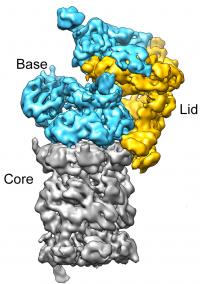
Berkeley researchers have provided the most detailed look ever at the “regulatory particle” used by proteasomes to identify and degrade proteins that have been marked for destruction. Important new information on one of the most critical protein machines in living cells has been reported by a team of researchers with the U.S. Department of Energy's Lawrence Berkeley National Laboratory (Berkeley Lab) and the University of California (UC) Berkeley. The researchers have provided the most detailed look ever at the "regulatory particle" used by the protein machines known as proteasomes to identify and degrade proteins that have been marked for destruction. The activities controlled by this regulatory particle are critical to the quality control of cellular proteins, as well as a broad range of vital biochemical processes, including transcription, DNA repair and the immune defense system.

| Molecular & Cell Biology | January 11, 2012 06:10 PM |
| Full story | 0 Comments | 8430 views |

| Biology | January 11, 2012 06:10 PM |
LSU's Chris Austin recently discovered two new species of frogs in New Guinea, one of which is now the world's tiniest known vertebrate, averaging only 7.7 millimeters in size – less than one-third of an inch. It ousts Paedocypris progenetica, an Indonesian fish averaging more than 8 millimeters, from the record. Austin, leading a team of scientists from the United States including LSU graduate student Eric Rittmeyer, made the discovery during a three-month long expedition to the island of New Guinea, the world's largest and tallest tropical island.
| Full story | 0 Comments | 10013 views |

| Health & Medicine | January 11, 2012 04:28 AM |
Every year, Americans drink 13.8 billion gallons of soda, fruit punch, sweet tea, sports drinks, and other sweetened beverages—a mass consumption of sugar that is fueling soaring obesity and diabetes rates in the United States.
| Full story | 0 Comments | 9777 views |

| Biotechnology | January 11, 2012 04:28 AM |
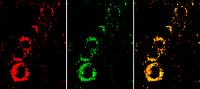
The yellow nanosensor signal in the overlay image (right) shows that the cells are active. If they were unhealthy, they would appear much redder. Center: the indicator dye signal. Left:... Countless mice, rats and rabbits die every year in the name of science – and the situation is getting worse. While German laboratories used some 2.41 million animals for scientific research in 2005, by 2009 this number had grown to 2.79 million. One third were destined for fundamental biology research, and the majority were used for researching diseases and developing medical compounds and devices. People demand medicines that are safe and therapies that are tolerable, but hardly anyone is happy to accept the need for animal testing. This is why scientists have spent years looking for methods that can replace them. Now researchers at the Fraunhofer Research Institution for Modular Solid State Technologies EMFT in Munich have found an alternative: they hope to use novel nanosensors to reduce the number of experiments that are carried out on animals. "We're basically using a test tube to study the effects of chemicals and their potential risks. What we do is take living cells, which were isolated from human and animal tissue and grown in cell cultures, and expose them to the substance under investigation," explains Dr. Jennifer Schmidt of the EMFT. If a given concentration of the substance is poisonous to the cell, it will die. This change in "well-being" can be rendered visible by the sensor nanoparticles developed by Dr. Schmidt and her team.
| Full story | 0 Comments | 13197 views |
| Health & Medicine | January 11, 2012 04:28 AM |
Researchers at Linköping University in Sweden are now launching a plan to effectively treat psoriasis.
| Full story | 0 Comments | 9130 views |
| Biotechnology | January 11, 2012 04:28 AM |
The available amount of fossil fuels is limited and their combustion in vehicle motors increases atmospheric carbon dioxide levels. The generation of fuels from biomass as an alternative is on the rise. In the journal Angewandte Chemie, Johannes A. Lercher and his team at the Technische Universitaet Muenchen have now introduced a new catalytic process that allows the effective conversion of biopetroleum from microalgae into diesel fuels.
| Full story | 0 Comments | 9569 views |

- In some genetic cases of microcephaly, stem cells fail to launch
- Yale team discovers how Zika virus causes fetal brain damage
- Scientists uncover the way a common cell enzyme alerts the body to invading bacteria
- Arctic gives clues on worst mass extinction of life
- Calcium channel blockers caught in the act at atomic level
Search Bio News Net
Free Biology Newsletter
- Flexibility That A.C.A. Lent to Work Force Is Threatened by...International Herald Tribune
- Bacteria Behind Legionnaires’ Disease Found at New York Police StationInternational Herald Tribune
- Prescription Price Crisis? 28 Million Americans See Spike in Drug...MSNBC.com: Health
- Seizing on Opioid Crisis, a Drug Maker Lobbies Hard for...International Herald Tribune
- Republicans are taking a big political risk on health careAP Health News
- Why We're So Divided Over Saving WolvesNational Geographic News