

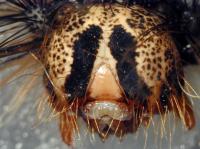
A photo of a Gypsy moth caterpillar 'face.' Gypsy moth caterpillars infected with baculovirus forfeit safety and stay in the treetops during the day because a virus gene manipulates their hormones to eat continuously and forego molting, according to entomologists. The caterpillars die where they climb and infect other gypsy moth caterpillars. "Normally, gypsy moth caterpillars are active at night," said Kelli Hoover, professor of entomology, Penn State. "They hide during the day in the soil or bark crevices protected from birds. They climb up the foliage at night to feed." Researchers have long known that gypsy moth caterpillars, like nearly all caterpillars, have baculoviruses that infect them and that a gene in the virus, egt, blocks molting in the caterpillar, keeping it in a feeding state. These viruses use most of the tissue of their hosts to reproduce and almost always kill their host.
| Full story | 0 Comments | 8823 views |

| Bioinformatics | September 12, 2011 08:28 AM |
A study involving more than 200,000 people worldwide has identified 29 DNA sequence variations in locations across the human genome that influence blood pressure. These genes, whose sequence changes are associated with alterations in blood pressure and are linked to heart disease and stroke, were found with the help of decades' worth of population data that were pooled and analyzed by a large international consortium, including Johns Hopkins researchers.
| Full story | 0 Comments | 7304 views |

| Stem Cell Research | September 12, 2011 08:28 AM |
Ever since human induced pluripotent stem cells were first derived in 2007, scientists have wondered whether they were functionally equivalent to embryonic stem cells, which are sourced in early-stage embryos.
| Full story | 0 Comments | 7121 views |

| Biotechnology | September 12, 2011 08:28 AM |
Molecules in their breath, sweat and skin have been used to detect humans in a simulation of a collapsed building, raising the prospect of portable sensors for use in real-life situations, such as the devastating aftermath of the 9/11 attacks and more recent disasters in New Zealand and Japan.
| Full story | 0 Comments | 9070 views |

- In some genetic cases of microcephaly, stem cells fail to launch
- Yale team discovers how Zika virus causes fetal brain damage
- Scientists uncover the way a common cell enzyme alerts the body to invading bacteria
- Arctic gives clues on worst mass extinction of life
- Calcium channel blockers caught in the act at atomic level
Search Bio News Net
Free Biology Newsletter
- Flexibility That A.C.A. Lent to Work Force Is Threatened by...International Herald Tribune
- Bacteria Behind Legionnaires’ Disease Found at New York Police StationInternational Herald Tribune
- Prescription Price Crisis? 28 Million Americans See Spike in Drug...MSNBC.com: Health
- Seizing on Opioid Crisis, a Drug Maker Lobbies Hard for...International Herald Tribune
- Republicans are taking a big political risk on health careAP Health News
- Why We're So Divided Over Saving WolvesNational Geographic News