

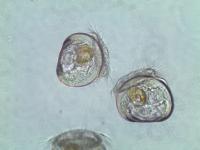
These are veliger-stage larvae of the California mussel, Mytilus californianus. Ocean acidification, a consequence of climate change, could weaken the shells of California mussels and diminish their body mass, with serious implications for coastal ecosystems, UC Davis researchers will report July 15 in the Journal of Experimental Biology.

| Environment | July 14, 2011 06:52 PM |
| Full story | 0 Comments | 8769 views |

| Molecular & Cell Biology | July 14, 2011 06:52 PM |
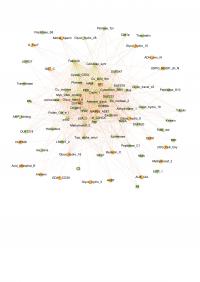
Networks of gene families of the seven analyzed plant species that are associated with the CesA genes Plants have neither supportive bone tissue nor muscles, and yet they can form rigid structures like stalks and even tree trunks. This is due to the fact that plant cells are enveloped by a stable cell wall. The main component of the plant cell wall is cellulose, which represents almost 50 percent of the total cell wall material and, at one billion tonnes per year, is the most frequently produced macromolecule in nature. Very little is known about the way in which cellulose is produced, and the knowledge that is available has mainly been obtained from the model plant thale cress (Arabidopsis thaliana) which, although easy to study, is of no economic significance. Staffan Persson and his research group at the Max Planck Institute of Molecular Plant Physiology have succeeded in showing that knowledge obtained in Arabidopsis can be applied to other plant species and even advanced.
| Full story | 0 Comments | 7647 views |

| Biotechnology | July 14, 2011 06:52 PM |
The power to edit genes is as revolutionary, immediately useful and unlimited in its potential as was Johannes Gutenberg's printing press. And like Gutenberg's invention, most DNA editing tools are slow, expensive, and hard to use—a brilliant technology in its infancy. Now, Harvard researchers developing genome-scale editing tools as fast and easy as word processing have rewritten the genome of living cells using the genetic equivalent of search and replace—and combined those rewrites in novel cell strains, strikingly different from their forebears.
| Full story | 0 Comments | 7398 views |

| Microbiology | July 14, 2011 06:52 PM |
A novel virus that spread through a California New World titi monkey colony in late 2009 has been shown to have also infected a human researcher and a household family member, in a documented example of an adenovirus "jumping" from one species to another and remaining contagious after the jump. Researchers at the UCSF Viral Diagnostics and Discovery Center, led by Dr. Charles Chiu, confirmed that the virus was the same in the New World monkeys and humans, and that the virus is highly unusual in both populations. Their findings appear July 14th in the Open Access journal PLoS Pathogens.
| Full story | 0 Comments | 7075 views |

- In some genetic cases of microcephaly, stem cells fail to launch
- Yale team discovers how Zika virus causes fetal brain damage
- Scientists uncover the way a common cell enzyme alerts the body to invading bacteria
- Arctic gives clues on worst mass extinction of life
- Calcium channel blockers caught in the act at atomic level
Search Bio News Net
Free Biology Newsletter
- Flexibility That A.C.A. Lent to Work Force Is Threatened by...International Herald Tribune
- Bacteria Behind Legionnaires’ Disease Found at New York Police StationInternational Herald Tribune
- Prescription Price Crisis? 28 Million Americans See Spike in Drug...MSNBC.com: Health
- Seizing on Opioid Crisis, a Drug Maker Lobbies Hard for...International Herald Tribune
- Republicans are taking a big political risk on health careAP Health News
- Why We're So Divided Over Saving WolvesNational Geographic News