

Researchers have discovered that the ultraviolet (UV) light that causes the temporary but painful condition of snow blindness in humans is life-saving for reindeer in the arctic.

| Biology | May 26, 2011 01:45 PM |
Some birds that live near noisy sites can alter their songs to deal with din. But closely related species with similar songs may tweak their tunes in different ways, says a new study led by Clinton Francis of the National Evolutionary Synthesis Center in Durham, NC.
| Full story | 0 Comments | 8525 views |

| Health & Medicine | May 26, 2011 01:45 PM |
Ionizing radiation is not without danger to human populations. Indeed, exposure to nuclear radiation leads to an increase in male births relative to female births, according to a new study by Hagen Scherb and Kristina Voigt from the Helmholtz Zentrum München. Their work shows that radiation from atomic bomb testing before the Partial Test Ban Treaty in 1963, the Chernobyl accident, and from living near nuclear facilities, has had a long-term negative effect on the ratio of male to female human births (sex odds). Their work is published in the June issue of Springer's journal, Environmental Science and Pollution Research.
| Full story | 1 Comment | 56981 views |
| Health & Medicine | May 26, 2011 01:45 PM |
A woman's risk of developing diabetes during pregnancy can be identified up to seven years before she becomes pregnant based on routinely assessed measures of blood sugar and body weight, according to a Kaiser Permanente study published in the online issue of the American Journal of Obstetrics and Gynecology.
| Full story | 0 Comments | 9159 views |

| Biotechnology | May 26, 2011 01:45 PM |
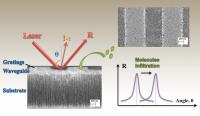
This figure shows how the sensor works. Light comes into the sensor at a particular angle. Part of the light is then reflected out (R), while part of it is... Vanderbilt University engineers have created a "spongy" silicon biosensor that shows promise not only for medical diagnostics, but also for the detection of dangerous toxins and other tiny molecules in the environment. This innovation was originally designed to detect the presence of particular DNA sequences, which can be extremely helpful in identifying whether or not a person is predisposed to heart disease or certain kinds of cancer. The new sensor is described in the Optical Society's open access journal, Optics Express.
| Full story | 0 Comments | 7255 views |

| Microbiology | May 26, 2011 01:45 PM |
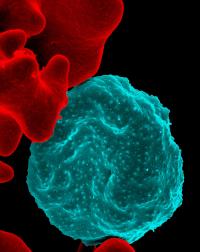
This is a colorized electron micrograph of red blood cell infected with malaria parasites (blue). The small bumps on the infected cell show how the parasite remodels its host... Snug inside a human red blood cell, the malaria parasite hides from the immune system and fuels its growth by digesting hemoglobin, the cell's main protein. The parasite, however, must obtain additional nutrients from the bloodstream via tiny pores in the cell membrane. Now, investigators from the National Institute of Allergy and Infectious Diseases (NIAID), part of the National Institutes of Health, have found the genes that malaria parasites use to create these feeding pores.
| Full story | 0 Comments | 8966 views |

- In some genetic cases of microcephaly, stem cells fail to launch
- Yale team discovers how Zika virus causes fetal brain damage
- Scientists uncover the way a common cell enzyme alerts the body to invading bacteria
- Arctic gives clues on worst mass extinction of life
- Calcium channel blockers caught in the act at atomic level
Search Bio News Net
Free Biology Newsletter
- Flexibility That A.C.A. Lent to Work Force Is Threatened by...International Herald Tribune
- Bacteria Behind Legionnaires’ Disease Found at New York Police StationInternational Herald Tribune
- Prescription Price Crisis? 28 Million Americans See Spike in Drug...MSNBC.com: Health
- Seizing on Opioid Crisis, a Drug Maker Lobbies Hard for...International Herald Tribune
- Republicans are taking a big political risk on health careAP Health News
- Why We're So Divided Over Saving WolvesNational Geographic News