

A vaccine developed by University of Melbourne researchers that could eradicate a fatal form of brain disease will be delivered to Peru next week, and could soon be commercially available thanks to multi-million dollar funding.

| Microbiology | October 29, 2008 07:11 PM |

Image shows swarm of M. xanthus bacteria (left) invading a colony of prey bacteria (right). The rippling pattern is the highly organized behavior of thousands of M. xanthus cells working in concert to digest the prey. Credit: John Kirby, University of Iowa Carver College of Medicine Like something from a horror movie, the swarm of bacteria ripples purposefully toward their prey, devours it and moves on.
| Full story | 0 Comments | 8147 views |

| Biology | October 29, 2008 07:11 PM |
In a twist on nontraditional uses of ultrasound, a group of neuroscientists at Arizona State University has developed pulsed ultrasound techniques that can remotely stimulate brain circuit activity. Their findings, published in the Oct. 29 issue of the journal Public Library of Science (PLoS) One, provide insights into how low-power ultrasound can be harnessed for the noninvasive neurostimulation of brain circuits and offers the potential for new treatments of brain disorders and disease.
| Full story | 0 Comments | 6766 views |
| Biology | October 29, 2008 07:11 PM |
A new study in the Journal of Marital and Family Therapy explored how men and women perceive online and offline sexual and emotional infidelity. Results show that men felt sexual infidelity was more upsetting and women felt emotional infidelity was more upsetting.
| Full story | 0 Comments | 8037 views |

| Health & Medicine | October 29, 2008 07:11 PM |
Prof. Stefanie Dimmeler, a researcher and director of the Institute for Cardiovascular Regeneration at Frankfurt's University Hospital has been awarded an ,ERC Advanced Grant' from the European Research Council to support her research work over the next five years. She will be investigating how to improve the healing process following a heart attack by promoting cardiovascular regeneration and the repair of heart tissue. This research application is one of eleven - Life Science - projects in Germany to be selected for funding, chosen from approximately 800 competitive applications from all over Europe.
| Full story | 0 Comments | 7290 views |

| Molecular & Cell Biology | October 29, 2008 07:11 PM |
As millions of Americans gear up for the Thanksgiving holiday, a new research report published online in The FASEB Journal (http://www.fasebj.org), may provide some relief for those leery of having a second helping. In the report, researchers describe a discovery that may allow some obese people avoid common obesity-related metabolic problems without actually losing weight: they make a common antioxidant, melanin, in excess. Even more promising is that some of the antioxidant drugs that can mimic the melanin effect are FDA-approved and available. This availability would greatly speed the development of new treatments, should they prove effective in clinical trials.
| Full story | 0 Comments | 8526 views |
| Biology | October 29, 2008 07:10 PM |
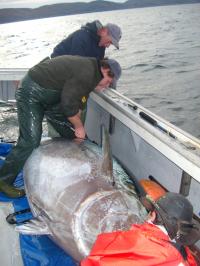
Dr. Michael Stokesbury of Dalhousie University tags a giant bluefin caught in the Gulf of St. Lawrence off Nova Scotia, Canada. The fish, estimated at 1,250 pounds, was released with the 1,000th electronic tag deployed through the Tag-A-Giant research campaign. Credit: Tag-A-Giant A giant Atlantic bluefin tuna weighing more than half a ton had the honor of being fitted with the 1000th electronic tracking tag placed on this threatened species when it was caught and released on Monday (October 20) in the Gulf of St. Lawrence off Port Hood, Nova Scotia.
| Full story | 0 Comments | 8827 views |
| Molecular & Cell Biology | October 29, 2008 07:10 PM |
Whether we choose to admit it or not, we all experience memory errors from time to time. Research has suggested that false memory may be a result of having too many other things to remember or perhaps if too much time has passed. However, previous studies have indicated that a specific type of false memory known as "boundary extension" occurs for different reasons. Boundary extension is a mistake that we often make when recalling a view of a scene—we will insist that the boundaries of an image stretched out farther than what we actually saw. Although this error is very common and occurs in people of all ages (from young children to the elderly), few studies have been done examining how quickly boundary extension occurs. That is, it was unknown how long a scene needs to be interrupted before the viewer experiences boundary extension and is convinced they saw more than they actually did.
| Full story | 0 Comments | 6777 views |
| Molecular & Cell Biology | October 29, 2008 07:10 PM |
Imagine a bathtub with two soap bubbles colliding but never fusing. Then you add detergent, and the surface of the water goes flat as the walls of the bubbles collapse and merge.
| Full story | 0 Comments | 6653 views |

- In some genetic cases of microcephaly, stem cells fail to launch
- Yale team discovers how Zika virus causes fetal brain damage
- Scientists uncover the way a common cell enzyme alerts the body to invading bacteria
- Arctic gives clues on worst mass extinction of life
- Calcium channel blockers caught in the act at atomic level
Search Bio News Net
Free Biology Newsletter
- Flexibility That A.C.A. Lent to Work Force Is Threatened by...International Herald Tribune
- Bacteria Behind Legionnaires’ Disease Found at New York Police StationInternational Herald Tribune
- Prescription Price Crisis? 28 Million Americans See Spike in Drug...MSNBC.com: Health
- Seizing on Opioid Crisis, a Drug Maker Lobbies Hard for...International Herald Tribune
- Republicans are taking a big political risk on health careAP Health News
- Why We're So Divided Over Saving WolvesNational Geographic News