

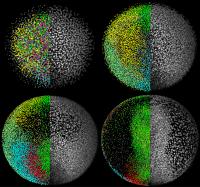
The montage shows the zebrafish digital embryo (left halves, colors encode movement directions of cells) and the microscopy data (right halves) at different time points in zebrafish development. Researchers at the European Molecular Biology Laboratory (EMBL) have generated a digital zebrafish embryo - the first complete developmental blueprint of a vertebrate. With a newly developed microscope scientists could for the first time track all cells for the first 24 hours in the life of a zebrafish. The data was reconstructed into a three-dimensional, digital representation of the embryo. The study, published in the current online issue of Science, grants many new insights into embryonic development. Movies of the digital embryo and the underlying database of millions of cell positions, divisions and tracks will be made publicly available to provide a novel resource for research and scientific training.

| Bioinformatics | October 11, 2008 12:53 AM |
| Full story | 0 Comments | 8242 views |

| Stem Cell Research | October 11, 2008 12:53 AM |
Shinya Yamanaka MD, PhD, of Kyoto University and the Gladstone Institute of Cardiovascular Disease (GICD) has taken another step forward in improving the possibilities for the practical application of induced pluripotent stem (iPS) cell technology.
| Full story | 0 Comments | 7301 views |

| Molecular & Cell Biology | October 11, 2008 12:53 AM |
DNA, the molecule that acts as the carrier of genetic information in all forms of life, is highly resistant against alteration by ultraviolet light, but understanding the mechanism for its photostability presents some puzzling problems. A key aspect is the interaction between the four chemical bases that make up the DNA molecule. Researchers at Kiel University have succeeded in showing that DNA strands differ in their light sensitivity depending on their base sequences. Their results are reported by Nina Schwalb and colleagues in the current issue of the journal Science appearing on October 10, 2008.
| Full story | 0 Comments | 7251 views |

| Microbiology | October 11, 2008 12:53 AM |
Researchers from the Genome Institute of Singapore (GIS) and its collaborators have now identified for the first time a new gene that may confer susceptibility to pulmonary tuberculosis. Their findings, published October 10 in the open access journal PLoS Genetics, reported that a gene named Toll-like receptor 8 (TLR8), previously shown only to recognize some factors from viruses such as the human immunodeficiency virus (HIV), has a probable role in human susceptibility to Mycobacterium tuberculosis infections. The results from the study also found that males are more susceptible than females.
| Full story | 0 Comments | 6357 views |
| Stem Cell Research | October 11, 2008 12:53 AM |
Researchers have identified stem cells with the capacity to build fat, according to a report in the October 17th issue of the journal Cell, a Cell Press publication. Although they have yet to show that the cells can renew themselves, transplants of the progenitor cells isolated from the fat tissue of normal mice can restore normal fat tissue in animals that are otherwise lacking it.
| Full story | 0 Comments | 6845 views |

- In some genetic cases of microcephaly, stem cells fail to launch
- Yale team discovers how Zika virus causes fetal brain damage
- Scientists uncover the way a common cell enzyme alerts the body to invading bacteria
- Arctic gives clues on worst mass extinction of life
- Calcium channel blockers caught in the act at atomic level
Search Bio News Net
Free Biology Newsletter
- Flexibility That A.C.A. Lent to Work Force Is Threatened by...International Herald Tribune
- Bacteria Behind Legionnaires’ Disease Found at New York Police StationInternational Herald Tribune
- Prescription Price Crisis? 28 Million Americans See Spike in Drug...MSNBC.com: Health
- Seizing on Opioid Crisis, a Drug Maker Lobbies Hard for...International Herald Tribune
- Republicans are taking a big political risk on health careAP Health News
- Why We're So Divided Over Saving WolvesNational Geographic News