

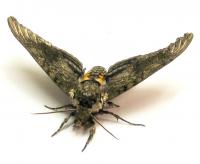
Researchers conditioned a moth to extend its proboscis in anticipation of a dollop of sucrose after being given a scent cue to study how the insect learned. Understanding how associations are built between stimuli and behavior can offer significant insights into how to build artificial systems to discriminate odors. Credit: I. Ito and R.C.Y. Ong, NIH Much like Pavlov conditioned his dog to salivate in anticipation of food when a bell rang, insects can be trained to perform certain behaviors when enticed with different smells. Researchers at the National Institutes of Health (NIH), the Chinese University of Hong Kong and the National Institute of Standards and Technology (NIST) have discovered that when training insects, the interval between the signal, or odor, and the reward—delicious sugar water—is everything. They also found that this process of building odor-sucrose associations would involve a mechanism that allows integration of neural activities (mental representations) that are not nearly coincident. Understanding how associations are built between stimuli and behavior gives insight into the nature of learning. Their findings were published online in Nature Neuroscience.

| Biology | October 2, 2008 09:15 PM |
| Full story | 0 Comments | 6502 views |

| Molecular & Cell Biology | October 2, 2008 09:15 PM |
Engineers long have known that great ideas can be lifted from Mother Nature, but a new paper* by researchers at Yale University and the National Institute of Standards and Technology (NIST) takes it to a cellular level. Applying modern engineering design tools to one of the basic units of life, they argue that artificial cells could be built that not only replicate the electrical behavior of electric eel cells but in fact improve on them. Artificial versions of the eel’s electricity generating cells could be developed as a power source for medical implants and other tiny devices, they say.
| Full story | 0 Comments | 7611 views |

| Microbiology | October 2, 2008 09:15 PM |
A bacteria cell's 'crisis command centre' has been observed for the first time swinging into action to protect the cell from external stress and danger, according to new research out today (3 October) in Science.
| Full story | 0 Comments | 6089 views |

| AIDS & HIV | October 2, 2008 09:15 PM |
The Salk Institute for Biological Studies and Burnham Institute for Medical Research today announced 295 host cell factors that are involved in human immunodeficiency virus (HIV) infection. The study, published in the Oct. 3 issue of Cell, could lead to the development of a new class of HIV therapeutics aimed at disrupting the human-HIV interactions that lead to viral infection.
| Full story | 0 Comments | 6902 views |
| Molecular & Cell Biology | October 2, 2008 09:15 PM |
Even cells commute. To get from their birthplace to their work site, they sequentially attach to and detach from an elaborate track of exceptionally strong proteins known as the extracellular matrix. Now, in research to appear in the October 3 issue of Cell, scientists at the Howard Hughes Medical Institute and Rockefeller University show that a molecule, called ACF7, helps regulate and power this movement from the inside - findings that could have implications for understanding how cancer cells metastasize.
| Full story | 0 Comments | 5903 views |
| Microbiology | October 2, 2008 09:15 PM |
A new study shows that the DNA of so-called "good bacteria" that normally live in the intestines may help defend the body against infection.
| Full story | 0 Comments | 8072 views |
| Biology | October 2, 2008 09:15 PM |
The Atlantic bluefin tuna is the largest and most sought-after of all tunas, weighing as much as 1,400 pounds and capable of fetching as much as $50,000 or more in Asian markets where its meat is a prized commodity, one big reason why its numbers have declined precipitously since the 1970s. New research findings reported in Science have critical implications for how bluefin tuna are managed on both sides of the Atlantic Ocean.
| Full story | 0 Comments | 6478 views |
| Biology | October 2, 2008 09:15 PM |
Humans living in communities often rely on friends to help get what they need and, according to researchers in the lab of Cameron Currie at the University of Wisconsin-Madison, many microbes, plants and animals benefit from 'friendly' associations too.
| Full story | 0 Comments | 5946 views |
| Molecular & Cell Biology | October 2, 2008 08:53 AM |
Small stretches of seemingly useless DNA harbor a big secret, say researchers at the Stanford University School of Medicine. There's one problem: We don't know what it is. Although individual laboratory animals appear to live happily when these genetic ciphers are deleted, these snippets have been highly conserved throughout evolution.
| Full story | 0 Comments | 7374 views |

| Biotechnology | October 2, 2008 08:53 AM |
Purdue University researchers have developed a method of using nanoparticles to deliver treatments to injured brain and spinal cord cells.
| Full story | 0 Comments | 6071 views |
| AIDS & HIV | October 2, 2008 08:53 AM |
New research indicates that the most pervasive global strain of HIV began spreading among humans between 1884 and 1924, not during the 1930s, as previously reported. The earlier period of origin coincides with the establishment of urban centers in the west-central African region where the epidemic of this particular HIV strain—HIV-1 group M—emerged. This suggests that urbanization and associated high-risk behaviors set the stage for the HIV/AIDS pandemic.
| Full story | 0 Comments | 5736 views |
| Microbiology | October 2, 2008 08:53 AM |
An interdisciplinary group of scientists has obtained the first detailed information about the structure of the most destructive group of plant viruses known: flexible filamentous viruses.
| Full story | 0 Comments | 7757 views |
| Molecular & Cell Biology | October 2, 2008 08:53 AM |
MicroRNAs, the tiny molecules that fine-tune gene expression, were first discovered in 1993. But it turns out they've been around for a billion years.
| Full story | 0 Comments | 6323 views |
| AIDS & HIV | October 2, 2008 08:53 AM |
After improving the sensitivity of nuclear magnetic resonance (NMR), researchers at the University of Missouri actually watched the HIV-1 protease mature from an inactive form into an active infection. This process has never been directly visualized before. The findings appear today in the journal Nature.
| Full story | 0 Comments | 5732 views |
| AIDS & HIV | October 2, 2008 08:53 AM |
As many as one quarter of HIV patients have drug resistance, limiting their treatment options and raising their risk for AIDS and death. Now, maraviroc, the first of a new class of HIV drugs called CCR5 receptor antagonists, has been shown to be effective over 48 weeks for drug-resistant patients with R5 HIV-1, a variation of the virus found in more than half of HIV-infected patients.
| Full story | 0 Comments | 5862 views |

- In some genetic cases of microcephaly, stem cells fail to launch
- Yale team discovers how Zika virus causes fetal brain damage
- Scientists uncover the way a common cell enzyme alerts the body to invading bacteria
- Arctic gives clues on worst mass extinction of life
- Calcium channel blockers caught in the act at atomic level
Search Bio News Net
Free Biology Newsletter
- Flexibility That A.C.A. Lent to Work Force Is Threatened by...International Herald Tribune
- Bacteria Behind Legionnaires’ Disease Found at New York Police StationInternational Herald Tribune
- Prescription Price Crisis? 28 Million Americans See Spike in Drug...MSNBC.com: Health
- Seizing on Opioid Crisis, a Drug Maker Lobbies Hard for...International Herald Tribune
- Republicans are taking a big political risk on health careAP Health News
- Why We're So Divided Over Saving WolvesNational Geographic News