

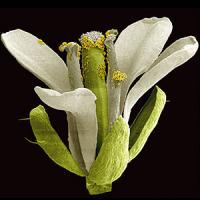
Thale cress Arabidopsis thaliana. Plants that grow more slowly stay fresh longer. In their study now published in PLoS Biology, scientists at the Max Planck Institute for Developmental Biology in Tübingen have shown that certain small sections of genes, so-called microRNAs, coordinate growth and aging processes in plants. These microRNAs inhibit certain regulators, known as TCP transcription factors. These transcription factors in turn influence the production of jasmonic acid, a plant hormone. The higher the number of microRNAs present, the lower the number of transcription factors that are active, and the smaller the amount of jasmonic acid, which is produced by the plant. The plant therefore ages more slowly, as this hormone is important for the plant's aging processes. The researchers have succeeded for the first time in describing the antagonistic regulation of growth and aging in plants. Since the quantity of microRNAs in the plants can be controlled by genetic methods, it may be possible in future to cultivate plants that live longer and grow faster. (PLoS Biology, September 23, 2008)

| Biology | September 23, 2008 11:57 AM |
| Full story | 0 Comments | 21746 views |
| Biology | September 23, 2008 11:57 AM |

Hybrid tortoise on Volcano Wolf. Yale scientists report that genetic traces of extinct species of Galapagos tortoises exist in descendants now living in the wild, a finding that could spur breeding programs to restore the species, The report appears in Proceedings of the National Academy of Sciences.
| Full story | 0 Comments | 20422 views |

| Health & Medicine | September 23, 2008 11:57 AM |
Honey is very effective in killing bacteria in all its forms, especially the drug-resistant biofilms that make treating chronic rhinosinusitis difficult, according to research presented during the 2008 American Academy of Otolaryngology-Head and Neck Surgery Foundation (AAO-HNSF) Annual Meeting & OTO EXPO, in Chicago, IL.
| Full story | 0 Comments | 19474 views |

| Biotechnology | September 23, 2008 11:57 AM |
Researchers at The Johns Hopkins University School of Medicine in Baltimore have developed a novel test to screen for chemical modifications to DNA known as methylation. The technology potentially could be used both for early cancer diagnoses and for assessing patients' response to cancer therapies.
| Full story | 0 Comments | 17589 views |

| Environment | September 23, 2008 11:57 AM |
Scientists at the University of Illinois have developed a new class of disposable, microplate-based optical biosensors capable of detecting protein-DNA interactions. Based on the properties of photonic crystals, the biosensors are suitable for the rapid identification of inhibitors of protein-nucleic acid and protein-protein interactions.
| Full story | 0 Comments | 18938 views |

| Bioinformatics | September 23, 2008 11:57 AM |
North Carolina State University scientists and colleagues have completed the genome sequence and genetic map of one of the world's most common and destructive plant parasites - Meloidogyne hapla, a microscopic, soil-dwelling worm known more commonly as the northern root-knot nematode.
| Full story | 0 Comments | 19581 views |
| Biology | September 23, 2008 11:57 AM |
An unusual breed of dinosaur that was the size of a chicken, ran on two legs and scoured the ancient forest floor for termites is the smallest dinosaur species found in North America, according to a University of Calgary researcher who analyzed bones found during the excavation of an ancient bone bed near Red Deer, Alberta.
| Full story | 0 Comments | 19088 views |

- In some genetic cases of microcephaly, stem cells fail to launch
- Yale team discovers how Zika virus causes fetal brain damage
- Scientists uncover the way a common cell enzyme alerts the body to invading bacteria
- Arctic gives clues on worst mass extinction of life
- Calcium channel blockers caught in the act at atomic level
Search Bio News Net
Free Biology Newsletter
- Flexibility That A.C.A. Lent to Work Force Is Threatened by...International Herald Tribune
- Bacteria Behind Legionnaires’ Disease Found at New York Police StationInternational Herald Tribune
- Prescription Price Crisis? 28 Million Americans See Spike in Drug...MSNBC.com: Health
- Seizing on Opioid Crisis, a Drug Maker Lobbies Hard for...International Herald Tribune
- Republicans are taking a big political risk on health careAP Health News
- Why We're So Divided Over Saving WolvesNational Geographic News