

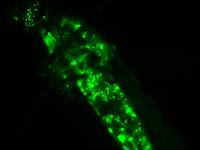
Anopheles gambiae mosquito infected with GFP-expressing AgDNV. Researchers at the Johns Hopkins Bloomberg School of Public Health's Malaria Research Institute have identified a previously unknown virus that is infectious to Anopheles gambiae—the mosquito primarily responsible for transmitting malaria. According to the researchers, the discovered virus could one day be used to pass on new genetic information to An. gambiae mosquitoes as part of a strategy to control malaria, which kills over one million people worldwide each year. The study was published August 22 online in the peer-reviewed open access journal PLoS Pathogens.

| Microbiology | August 22, 2008 04:15 PM |
| Full story | 0 Comments | 9746 views |

| Biology | August 22, 2008 04:15 PM |
Throughout history, elephants have been thought of as 'different'. Shakespeare, and even Aristotle, described them as walking on inflexible column-like legs. And this myth persists even today. Which made John Hutchinson from The Royal Veterinary College, London, want to find out more about elephants and the way they move. Are they really that different from other, more fleet-footed species? Are their legs as rigid and 'columnar' as people had thought? Traveling to Thailand and several UK zoos, Hutchinson and his team investigated how Asian Elephants move their legs as they walk and run and publishes his results in The Journal of Experimental Biology on August 22 2008 at http://jeb.biologists.org
| Full story | 0 Comments | 7226 views |

| Molecular & Cell Biology | August 22, 2008 04:15 PM |
This press release is available in German.
| Full story | 0 Comments | 7665 views |

| Bioinformatics | August 22, 2008 04:15 PM |
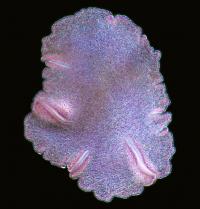
Trichoplax adhaerens. As Aesop said, appearances are deceiving—even in life's tiniest critters. From first detection in the 1880s, clinging to the sides of an aquarium, to its recent characterization by the U.S. Department of Energy Joint Genome Institute (DOE JGI), a simple and primitive animal, Trichoplax adhaerens, appears to harbor a far more complex suite of capabilities than meets the eye. The findings, reported in the August 21 online edition of the journal Nature, establish a group of organisms as a branching point of animal evolution and identify sets of genes, or a "parts list," employed by organisms that have evolved along particular branches.
| Full story | 0 Comments | 10356 views |
| Biology | August 22, 2008 04:15 PM |
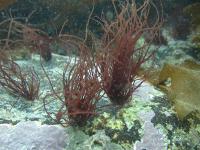
Healthy red algae (Devaleraea ramentacea). It is red, it burns and itches: a sunburn on our skin. However, too much sun is not only bad for humans. Many plants react sensitively to an increased dose of ultraviolet radiation, too. Yet they are dependent on sunlight. With the help of pigments absorbing solar energy and light, plants produce their vitally important building blocks by means of photosynthesis. However, this has its limits: too much sun means an over-abundance of energy and thus the destruction of the sensitive pigments. The result are black spots, pale leaves and rotten parts.
| Full story | 0 Comments | 9160 views |

| Health & Medicine | August 22, 2008 04:15 PM |
Beware of mini-packs and mini-foods, especially if you're a dieter.
| Full story | 0 Comments | 7436 views |

- In some genetic cases of microcephaly, stem cells fail to launch
- Yale team discovers how Zika virus causes fetal brain damage
- Scientists uncover the way a common cell enzyme alerts the body to invading bacteria
- Arctic gives clues on worst mass extinction of life
- Calcium channel blockers caught in the act at atomic level
Search Bio News Net
Free Biology Newsletter
- Flexibility That A.C.A. Lent to Work Force Is Threatened by...International Herald Tribune
- Bacteria Behind Legionnaires’ Disease Found at New York Police StationInternational Herald Tribune
- Prescription Price Crisis? 28 Million Americans See Spike in Drug...MSNBC.com: Health
- Seizing on Opioid Crisis, a Drug Maker Lobbies Hard for...International Herald Tribune
- Republicans are taking a big political risk on health careAP Health News
- Why We're So Divided Over Saving WolvesNational Geographic News