


Commercial venues are very aware of the effects that the environment – in this case, music – can have on in-store traffic flow, sales volumes, product choices, and consumer time spent in the immediate vicinity. A study of the effects of music levels on drinking in a bar setting has found that loud music leads to more drinking in less time.

| Biotechnology | July 21, 2008 07:50 PM |
For the first time, researchers have successfully grown functional human blood vessels in mice using cells from adult human donors — an important step in developing clinical strategies to grow tissue, researchers report in Circulation Research: Journal of the American Heart Association.
| Full story | 0 Comments | 6993 views |

| AIDS & HIV | July 21, 2008 05:12 PM |
When individuals infected with HIV become infected with a second strain of the virus, the two viral strains can exchange genetic information, creating a third, recombinant strain of the virus. It is known that the presence of multiple viral strains, called superinfection, frequently leads to a loss of immune control of viral levels. Now a study from the Partners AIDS Research Center at Massachusetts General Hospital (PARC/MGH) shows that how and where viral strains swap DNA may be determined by the immune response against the original infecting strain. Their report will appear in the Journal of Experimental Medicine and has been released online.
| Full story | 0 Comments | 7607 views |

| Biology | July 21, 2008 04:50 PM |
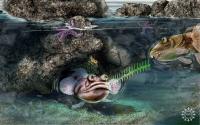
An artist's representation shows the midshipman fish singing to attract a mate. Talking fish are no strangers to Americans. From the comedic portrayal of "Mr. Limpet" by Don Knotts, to the children's Disney favorite, "Nemo," fish can talk, laugh and tell jokes--at least on television and the silver screen. But can real fish verbally communicate? Researchers say, "Yes," in a paper published in the July 18 issue of the journal Science. Further, the findings put human speech--and social communications of all vertebrates--in evolutionary context.
| Full story | 0 Comments | 7270 views |
| AIDS & HIV | July 21, 2008 01:50 PM |
New research into the earliest events occurring immediately upon infection with HIV-I shows that the virus deals a stunning blow to the immune system earlier than was previously understood. According to scientists at Duke University Medical Center, this suggests the window of opportunity for successful intervention may be only a matter of days – not weeks – after transmission, as researchers had previously believed.
| Full story | 0 Comments | 6308 views |

| Microbiology | July 21, 2008 10:50 AM |
Viruses achieve their definition of success when they can thrive without killing their host. Now, biologists Pamela Bjorkman and Zhiru Yang of the California Institute of Technology have uncovered how one such virus, prevalent in humans, evolved over time to hide from the immune system.
| Full story | 0 Comments | 5959 views |

- In some genetic cases of microcephaly, stem cells fail to launch
- Yale team discovers how Zika virus causes fetal brain damage
- Scientists uncover the way a common cell enzyme alerts the body to invading bacteria
- Arctic gives clues on worst mass extinction of life
- Calcium channel blockers caught in the act at atomic level
Search Bio News Net
Free Biology Newsletter
- Flexibility That A.C.A. Lent to Work Force Is Threatened by...International Herald Tribune
- Bacteria Behind Legionnaires’ Disease Found at New York Police StationInternational Herald Tribune
- Prescription Price Crisis? 28 Million Americans See Spike in Drug...MSNBC.com: Health
- Seizing on Opioid Crisis, a Drug Maker Lobbies Hard for...International Herald Tribune
- Republicans are taking a big political risk on health careAP Health News
- Why We're So Divided Over Saving WolvesNational Geographic News