

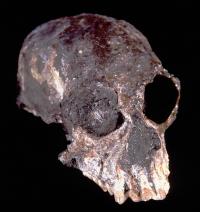
Fossil Chilecebus from South America. After taking a fresh look at an old fossil, John Flynn, Frick Curator of Paleontology at the American Museum of Natural History, and colleagues determined that the brains of the ancestors of modern Neotropical primates were as small as those of their early fossil simian counterparts in the Old World. This means one of the hallmarks of primate biology, increased brain size, arose independently in isolated groups—the platyrrhines of the Americas and the catarrhines of Africa and Eurasia.

| Biology | July 9, 2008 10:57 PM |
| Full story | 0 Comments | 7070 views |

| AIDS & HIV | July 9, 2008 10:57 PM |
In battle with an epidemic that has outpaced nearly all efforts to contain it, researchers are turning to strategies centered on the same antiretroviral (ARV) drugs that have been used successfully to treat HIV in hopes they will be as effective a stronghold for preventing the virus. For women, who make up nearly half of the 33 million people living with HIV/AIDS worldwide, the ARV tenofovir has particular promise because it can be formulated as either an oral tablet or a vaginal gel to be used daily. But ARV-based prevention approaches are not without scientific and practical challenges. The Microbicide Trials Network (MTN) is taking aim at among the most pressing of these challenges in the first clinical trial to directly compare the tablet and vaginal gel formulations of tenofovir.
| Full story | 0 Comments | 7042 views |

| Microbiology | July 9, 2008 10:57 PM |
A key enzyme may explain how hepatitis C infection causes fatty liver – a buildup of excess fat in the liver, which can lead to life-threatening diseases such as cirrhosis and liver cancer, report University of Pittsburgh Graduate School of Public Health and School of Medicine researchers.
| Full story | 0 Comments | 7313 views |

| Stem Cell Research | July 9, 2008 10:57 PM |
Barcelona, Spain: For the first time in the world scientists have succeeded in developing human embryonic stem cells (hESCs) from a single cell, or blastomere, of a 4-cell stage embryo, the 24th annual conference of the European Society of Human Reproduction and Embryology heard today (Wednesday 9 July). Dr. Hilde Van de Velde, from the Vrije Universiteit Brussel (VUB), Brussels, Belgium, said that their research meant that it might be possible in the future to produce hESC lines at an earlier stage without destroying the embryo.
| Full story | 0 Comments | 8801 views |

| Molecular & Cell Biology | July 9, 2008 10:57 PM |
Neurons in brains of one songbird species equipped with a built-in suicide program that kicks in at the end of the breeding season have been kept alive for seven days in live birds by researchers trying to understand the role that steroid hormones play in the growth and maintenance of the neural song system.
| Full story | 0 Comments | 6326 views |
| Microbiology | July 9, 2008 10:57 PM |
Described in the July 10, 2008 issue of the journal Nature, the research reveals the shape of the Ebola virus spike protein, which is necessary for viral entry into human cells, bound to an immune system antibody acting to neutralize the virus. The structure provides a major step forward in understanding how the deadly virus works, and may be useful in the development of potential Ebola virus vaccines, or treatments for those infected.
| Full story | 0 Comments | 9884 views |

| Biotechnology | July 9, 2008 10:57 PM |
Many coaches inspire better performance by pressuring their teams. Now, proteomics researchers are using pressure to improve the performance of their analyses. In a simple solution to a time-consuming problem, the researchers have found that adding pressure early in their protocol squeezes four hours of waiting into a minute.
| Full story | 0 Comments | 6784 views |
| Biology | July 9, 2008 10:57 PM |
A newly identified fossil and the reinterpretation of previously known fossils, all from Europe and about 50 million years old, fill in a "missing link" in the evolution of flatfishes and explain one of nature's most extraordinary phenomena.
| Full story | 0 Comments | 7719 views |
| Microbiology | July 9, 2008 12:40 AM |
Scientists have discovered how bird flu adapts in patients, offering a new way to monitor the disease and prevent a pandemic, according to research published in the August issue of the Journal of General Virology. Highly pathogenic H5N1 avian influenza virus has spread through at least 45 countries in 3 continents. Despite its ability to spread, it cannot be transmitted efficiently from human to human. This indicates it is not fully adapted to its new host species, the human. However, this new research reveals mutations in the virus that may result in a pandemic.
| Full story | 1 Comment | 9202 views |

| Environment | July 9, 2008 12:40 AM |
Scientists announced today the discovery of reef structures they believe doubles the size of the Southern Atlantic Ocean's largest and richest reef system, the Abrolhos Bank, off the southern coast of Brazil's Bahia state. The newly discovered area is also far more abundant in marine life than the previously known Abrolhos reef system, one of the world's most unique and important reefs.
| Full story | 0 Comments | 6935 views |
| Microbiology | July 9, 2008 12:40 AM |
A new study—done on a scale an order of magnitude greater than anything previously attempted in the field of malaria—has uncovered an arsenal of proteins produced by the malaria parasite that allows it to hijack and remodel human red blood cells, leaving the oxygen-carrying cells stiff and sticky. Those effects on the blood cells play a major role in the development of malaria, a disease responsible for millions of deaths every year, the researchers report in the July 11th issue of the journal Cell, a Cell Press publication.
| Full story | 0 Comments | 6800 views |
| Molecular & Cell Biology | July 9, 2008 12:40 AM |
The autistic disorder, a neurodevelopmental disease first described in 1943, represents a challenge for treatment and a puzzle for research. Alongside Asperger syndrome, a milder form of the disorder, autism is classified in the continuum of various Autism Spectrum Disorders (ASD), all of which are characterized by deficits in language, social interaction, and a strangely restricted and repetitive behaviour (stereotypy). Disease onset occurs during the first three years of life. The earlier the disorder is diagnosed, the sooner the child can be helped through treatment interventions, but unfortunately detection is often delayed. In a vast majority of cases, no disease causes can be identified.
| Full story | 0 Comments | 7575 views |

| Health & Medicine | July 9, 2008 12:40 AM |
The humble tomato could be a suitable carrier for an oral vaccine against Alzheimer's disease, according to HyunSoon Kim from the Korea Research Institute of Bioscience and Biotechnology (KRIBB) in Korea and colleagues from Digital Biotech Inc. and the Department of Biological Science at Wonkwang University. Although their research (1), just published online in Springer's journal Biotechnology Letters, is still in the early stages, it is a promising first step towards finding an edible vaccine against the neurodegenerative disease.
| Full story | 0 Comments | 10961 views |
| AIDS & HIV | July 9, 2008 12:40 AM |
Weak HIV viruses piggyback onto stronger ones, raising the possibility that the human body may harbor many more HIV viruses capable of replicating and contributing to the development of AIDS than previously thought, a New York University College of Dentistry AIDS research team has found.
| Full story | 0 Comments | 6591 views |

- In some genetic cases of microcephaly, stem cells fail to launch
- Yale team discovers how Zika virus causes fetal brain damage
- Scientists uncover the way a common cell enzyme alerts the body to invading bacteria
- Arctic gives clues on worst mass extinction of life
- Calcium channel blockers caught in the act at atomic level
Search Bio News Net
Free Biology Newsletter
- Flexibility That A.C.A. Lent to Work Force Is Threatened by...International Herald Tribune
- Bacteria Behind Legionnaires’ Disease Found at New York Police StationInternational Herald Tribune
- Prescription Price Crisis? 28 Million Americans See Spike in Drug...MSNBC.com: Health
- Seizing on Opioid Crisis, a Drug Maker Lobbies Hard for...International Herald Tribune
- Republicans are taking a big political risk on health careAP Health News
- Why We're So Divided Over Saving WolvesNational Geographic News