
 Print Article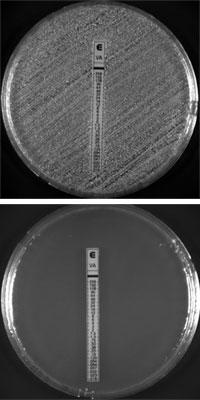
Strains of bacteria that are resistant to the antibiotic vancomycin grow easily in its presence (top), but are completely eliminated (bottom) when exposed to Ceftobiprole. The problem with antibiotics is that, eventually, bacteria outsmart them and become resistant. But by targeting the gene that confers such resistance, a new drug may be able to finally outwit them. Rockefeller University scientists tested the new drug, called Ceftobiprole, against some of the deadliest strains of multidrug-resistant Staphylococcus aureus (MRSA) bacteria, which are responsible for the great majority of staphylococcal infections worldwide, both in hospitals and in the community.
The research, to be published in the August 2008 issue of the journal Antimicrobial Agents and Chemotherapy and available online now, looked at how well Ceftobiprole worked against bacterial clones that had already developed resistance to other drugs. In every case, Ceftobiprole won. "It just knocked out the cells 100 percent," says the study's lead investigator, Alexander Tomasz, head of the Laboratory of Microbiology at Rockefeller.
Previous research had already shown that -- in general -- Ceftobiprole was highly effective against most clinical isolates of S. aureus. "Instead, we looked more carefully at the highly resistant cells that already occur in such clinical isolates at very low frequency -- maybe in one bacterium in every 1,000," says Tomasz. Ceftobiprole was able to kill these resistant cells.
Never before has an antibiotic been tested this way. "In the history of antibiotic development, an antibiotic arrives on the scene, and sooner or later resistant bacteria emerge," Tomasz says. "We sought to test in advance which would win this particular chess game: the new drug, or the bacteria that now cause human deaths."
In an ominous new "move" in this chess game, S. aureus strains with resistance to vancomycin (VRSA), a different class of antibiotics, also began to appear in hospitals in the United States. Ceftobiprole was also able to kill these new resistant VRSA strains.
The drug is effective because the chemists who developed Ceftobiprole managed to outwit the bacteria at their own game, Tomasz says. The broad-spectrum antibiotic was discovered by Basilea Pharmaceuticals, based in Basel, Switzerland, and is being developed in the U.S. and worldwide by Johnson & Johnson. The research was supported by Johnson & Johnson along with a grant from the U.S. Public Health Service.
Source : Rockefeller University
 Mail to a Friend
 Link to this article

