

No-take marine reserves, in which fishing is completely banned, can lead to very rapid comebacks of the fish species most prized by commercial and recreational fisheries, reveals a new study of Australia's Great Barrier Reef published in the June 24th issue of Current Biology, a Cell Press publication.

| Biology | June 23, 2008 04:10 PM |
For the first time, researchers have shown that the pre-hatching calls of baby Nile crocodiles actually mean something to their siblings and to their mothers. The calls—which are perfectly audible to humans and sound like "umph! umph! umph!"—tell the others in the nest that it's time to hatch, according to the report in the June 23rd issue of Current Biology, a Cell Press publication. Those cries also tell the mother croc to start digging up the nest.
| Full story | 0 Comments | 6632 views |
| Biology | June 23, 2008 04:10 PM |
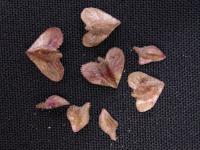
Plants at range limits produce seeds with larger wings, Dr. Eckert discovered. The hardiest plants and those most likely to survive the climatic shifts brought about by global warming are now easier to identify, thanks to new research findings by a team from Queen's University.
| Full story | 0 Comments | 5446 views |
| Biology | June 23, 2008 04:10 PM |
Biologists at Harvard University have determined that some African frogs carry concealed weapons: When threatened, these species puncture their own skin with sharp bones in their toes, using the bones as claws capable of wounding predators.
| Full story | 0 Comments | 6572 views |

| Molecular & Cell Biology | June 23, 2008 04:10 PM |
Cells with irreparable DNA damage normally induce programmed cell death, or apoptosis. However, this mechanism often fails in tumor cells so that transformed cells are able to multiply and spread throughout the body. Scientists at the German Cancer Research Center (Deutsches Krebsforschungszentrum, DKFZ) have now discovered a possible cause of this failure. Tumor cells simply degrade a protein that triggers apoptosis in the case of DNA damage. Blocking this protein degradation might set apoptosis back in operation and, thus, increase the effectiveness of radiotherapy or chemotherapy. The researchers have now published their results in Nature Cell Biology.
| Full story | 1 Comment | 8254 views |

| Biotechnology | June 23, 2008 04:10 PM |

Each of these jars contains the same substance. The difference is the size of the particles. Quantum dots, suspended in liquid, absorb white light and then reemit it in a specific color that depends on the particle's size. Each quantum dot is about one ten-millionth of an inch in diameter and is composed of a few hundred atoms of material. Credit: Xiaohu Gao, University of Washington
| Full story | 0 Comments | 6665 views |
| Biology | June 23, 2008 04:10 PM |
One dose of an insecticide can kill three generations of cockroaches as they feed off of each other and transfer the poison, according to Purdue University entomologists who tested the effectiveness of a specific gel bait.
| Full story | 0 Comments | 5994 views |

| Environment | June 23, 2008 04:10 PM |
Prior to the federal Clean Air Act, unhindered industrial emissions were released into the air throughout the Midwestern and Eastern United States for decades. Many of those harmful chemicals came right back down to earth in the form of acid rain, a chemical concoction that includes nitric and sulfuric acid.
| Full story | 0 Comments | 7656 views |

| Stem Cell Research | June 23, 2008 01:45 AM |
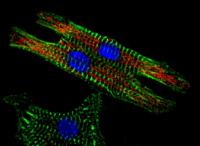
Pu and Zhou tagged the Wt-1 expressing epicardial cells with a fluorescent red protein, then allowed the cells to differentiate. The image shows a descendent cardiomyocyte (green) that carries the same red marker, and another cell that arose from different origins. (The blue stain indicates cell nuclei). Credit: Bin Zhou, MD (Children's Hospital Boston) Researchers at Children's Hospital Boston are continuing to document the heart's earliest origins. Now, they have pinpointed a new, previously unrecognized group of stem cells that give rise to cardiomyocytes, or heart muscle cells. These stem cells, located in the surface of the heart, or epicardium, advance the hope of being able to regenerate injured heart tissue.
| Full story | 0 Comments | 6082 views |
| Biotechnology | June 23, 2008 01:45 AM |
Researchers from Northwestern University and Texas A & M University have discovered a new way to limit gene transfer and expression to specific tissues in animals. In studies to determine how plasmids enter the nuclei of non-dividing cells, the group previously identified a region of a smooth muscle cell-specific promoter that was able to mediate nuclear targeting of any plasmid carrying this sequence uniquely in cultured smooth muscle cells but in no other cell type. In their current study to appear in the July 08 issue of Experimental Biology and Medicine, the team, led by Drs. David Dean and Jennifer Young from the Department of Medicine at Northwestern University, in collaboration with Warren Zimmer from Texas A & M University, now demonstrate that such restriction of nuclear entry using this specific DNA sequence can be used in blood vessels of living animals to direct gene transfer and expression specifically to smooth muscle cells. They have also developed a novel gene delivery approach for the vasculature that uses an electric field to transiently permeabilize the plasma membrane of cells to allow entry of DNA. Thus, this work establishes the control of nuclear entry of gene therapy vectors as a novel approach to target genes and gene expression to desired cell types in the body.
| Full story | 0 Comments | 5926 views |

- In some genetic cases of microcephaly, stem cells fail to launch
- Yale team discovers how Zika virus causes fetal brain damage
- Scientists uncover the way a common cell enzyme alerts the body to invading bacteria
- Arctic gives clues on worst mass extinction of life
- Calcium channel blockers caught in the act at atomic level
Search Bio News Net
Free Biology Newsletter
- Flexibility That A.C.A. Lent to Work Force Is Threatened by...International Herald Tribune
- Bacteria Behind Legionnaires’ Disease Found at New York Police StationInternational Herald Tribune
- Prescription Price Crisis? 28 Million Americans See Spike in Drug...MSNBC.com: Health
- Seizing on Opioid Crisis, a Drug Maker Lobbies Hard for...International Herald Tribune
- Republicans are taking a big political risk on health careAP Health News
- Why We're So Divided Over Saving WolvesNational Geographic News