

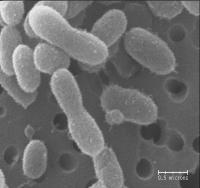
A scanning electron microscope image of the Chryseobacterium greenlandensis bacteria found in a Greenland glacier. A team of Penn State scientists has discovered a new ultra-small species of bacteria that has survived for more than 120,000 years within the ice of a Greenland glacier at a depth of nearly two miles. The microorganism's ability to persist in this low-temperature, high-pressure, reduced-oxygen, and nutrient-poor habitat makes it particularly useful for studying how life, in general, can survive in a variety of extreme environments on Earth and possibly elsewhere in the solar system. The work will be presented by Jennifer Loveland-Curtze, a senior research associate in the laboratory led by Jean Brenchley, Professor of Biochemistry and Molecular Biology at Penn State, at the 108th American Society for Microbiology General Meeting in Boston, Massachusetts on 3 June 2008 at 10:30 a.m. (Extreme Environments-I, poster N-156).

| Microbiology | June 3, 2008 07:05 PM |
| Full story | 0 Comments | 7421 views |
| Microbiology | June 3, 2008 07:05 PM |
Global climate change will not only impact plants and animals but will also affect bacteria, fungi and other microbial populations that perform a myriad of functions important to life on earth. It is not entirely certain what those effects will be, but they could be significant and will probably not be good, say researchers today at a scientific meeting in Boston.
| Full story | 0 Comments | 7280 views |

| Biology | June 3, 2008 07:05 PM |
Aging leads to large changes in gene activity in the ovaries of mice, but only limited changes in testes, according to research published in the open-access journal, BMC Biology. A lifespan-extending calorie-restricted diet reversed some of the aging effects – but, unlike the widespread changes observed in somatic organs, it had an impact only in a small number of gonad-specific genes.
| Full story | 0 Comments | 6643 views |

| Molecular & Cell Biology | June 3, 2008 07:05 PM |
Every year, one million Europeans are confronted with potentially irreparable brain or spinal cord injuries resulting from traffic accidents. Because the nerves in a damaged spinal cord cannot, or cannot fully, be repaired, the patient remains (partially) paralyzed. Now, VIB scientists connected to the K.U.Leuven have become the first to successfully develop a simple model that enables the study of injured brain tissue. The researchers have perfected a technique for keeping the cultured brain of a fruit fly alive and healthy for a longer period of time. With the aid of microsurgery, this new technique enables scientists to inflict injury on certain nerve bundles for research purposes. By means of this new fruit fly model, the researchers have already succeeded in showing that the activation of a particular signaling pathway (JNK) induces the regeneration of axons. This research offers positive perspectives for patients with nerve injuries that have been irreversible up to now.
| Full story | 0 Comments | 8108 views |
| Molecular & Cell Biology | June 3, 2008 07:05 PM |
Mammalian cells can produce tiny magnetic nuggets after the introduction of a single gene from bacteria, scientists have found. The gene MagA could become a valuable tool for tracking cells' movement through the body via magnetic resonance imaging (MRI), says Xiaoping Hu, PhD, professor of biomedical engineering at Emory University and the Georgia Institute of Technology.
| Full story | 0 Comments | 7289 views |

| Health & Medicine | June 3, 2008 07:05 PM |
You may not be what you eat after all.
| Full story | 0 Comments | 6436 views |
| Microbiology | June 3, 2008 07:05 PM |
A new study by a team of researchers at the Welsh School of Pharmacy, Cardiff University, Wales, UK, has found that antimicrobial-containing wipes currently used to decontaminate surfaces in hospitals can spread pathogens after first use. The research highlights concerns as to the suitability of the wipes currently being deployed and the importance of a routine surveillance program in reducing risks of infection to patients.
| Full story | 0 Comments | 6078 views |

- In some genetic cases of microcephaly, stem cells fail to launch
- Yale team discovers how Zika virus causes fetal brain damage
- Scientists uncover the way a common cell enzyme alerts the body to invading bacteria
- Arctic gives clues on worst mass extinction of life
- Calcium channel blockers caught in the act at atomic level
Search Bio News Net
Free Biology Newsletter
- Flexibility That A.C.A. Lent to Work Force Is Threatened by...International Herald Tribune
- Bacteria Behind Legionnaires’ Disease Found at New York Police StationInternational Herald Tribune
- Prescription Price Crisis? 28 Million Americans See Spike in Drug...MSNBC.com: Health
- Seizing on Opioid Crisis, a Drug Maker Lobbies Hard for...International Herald Tribune
- Republicans are taking a big political risk on health careAP Health News
- Why We're So Divided Over Saving WolvesNational Geographic News